
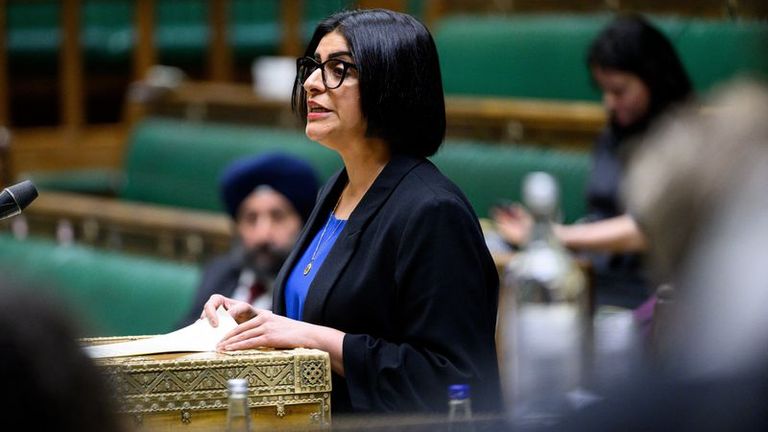
Britain's Home Secretary Shabana Mahmood has condemned violent protests that erupted in response to the case of Henry Nowak Police, an 18-year-old student who was handcuffed as he lay dying after his killer falsely claimed a racist attack, calling the disorder "completely unacceptable" while acknowledging the legitimate public anger at the heart of a case that has forced a national reckoning on police accountability. The murder of Nowak last December dominated British headlines following the life sentencing of his killer Vickrum Digwa on Monday, with bodycam footage showing officers restraining a dying innocent man while dismissing his pleas triggering a political storm that reaches directly into questions about how policing guidelines, institutional bias, and public trust intersect in modern Britain.
The public accountability dimension of the Nowak case is not reducible to the question of whether individual officers behaved badly, though the footage makes that question unavoidable. It reaches deeper into the institutional frameworks that govern how police are trained to respond when race is alleged as a factor in a street altercation, and whether those frameworks created a situation in which an innocent man's dying words were disbelieved while his killer's false accusation was acted upon. Hampshire Police has apologised for the incident. One of the officers involved has resigned. Three others are being treated as witnesses in an ongoing investigation by the Independent Office of Police Conduct. Each of those facts represents an accountability response, and each also raises its own further questions about whether the system that allowed this to happen is being genuinely examined or managed.
The government's position has been carefully calibrated. Ministers have welcomed the National Police Chiefs' Council's announcement that it is reviewing the language of existing guidance given to officers, while firmly denying the existence of a "two-tier" policing system that treats different ethnicities differently. Policing minister Sarah Jones told Sky News that while a review of the guidance language was appropriate, "that shouldn't be taken to mean we need to rip up the whole system." That framing reflects the impossible tightrope the government is walking: validating the public accountability concerns that the Nowak case has raised without conceding the political argument being made by Nigel Farage and others that the entire policing framework is institutionally discriminatory against white people.
How Henry Nowak Died and What the Bodycam Footage Revealed About Institutional Failure
The sequence of events that led to Henry Nowak's death began with a brief street altercation in Southampton last December. Nowak's killer, Vickrum Digwa, aged 23, lied to responding police officers, claiming that Nowak had racially abused and assaulted him during the encounter. Officers arrived to find Nowak on the ground. Bodycam footage, which has since been widely circulated and viewed, shows Nowak lying in the street saying "I've been stabbed" and "I can't breathe" while officers handcuff him. One officer's response, "I don't think you have, mate," has become the focal point of the accountability argument: that the false racial allegation made by Digwa caused officers to treat an innocent dying man as the perpetrator rather than the victim.
Court pathologists subsequently determined that Nowak would have died from his injuries regardless of the emergency response, a finding that is medically significant but does not address the accountability question of whether officers made the correct judgements with the information available to them in real time. Officers did eventually call an ambulance and perform CPR, facts that the policing establishment has cited in its initial response, but which have not satisfied Nowak's family or the wider public that due process was followed for a young man in his final minutes. His family described his treatment as "inhumane and degrading," language that carries a specific moral weight when applied to the conduct of law enforcement officers bound by professional and legal obligations of care.
Digwa was sentenced to life in prison on Monday, bringing the criminal justice dimension of the case to a formal conclusion. But the conviction of the killer, while necessary, does not answer the accountability questions about police conduct that the bodycam footage raised. Those questions are now the subject of an investigation by the Independent Office of Police Conduct, the statutory body responsible for oversight of police behaviour in England and Wales. The IOPC investigation will examine whether officers' actions were compliant with their training and guidelines, whether those guidelines themselves contributed to the outcome, and whether the individuals involved should face disciplinary or criminal consequences beyond the resignation already recorded.
What the Police Race Action Plan Review, IOPC Investigation, and Political Reaction Mean for Institutional Reform
The National Police Chiefs' Council's announcement that it is reviewing the language of its guidance to officers is the most significant institutional accountability response to emerge from the Nowak case so far. The guidance in question, issued as part of the Police Race Action Plan, advises officers not to be "colour blind" in their approach and to treat different ethnicities with awareness of historical and structural context. The intent behind that guidance is to address the well-documented reality of racial bias in policing, including the disproportionate use of stop-and-search against Black and minority ethnic individuals, a pattern that has been the subject of successive independent reviews and legal challenges over decades. Whether that guidance, applied in the specific circumstances of the Nowak case, contributed to officers' initial decision-making is the question the review must answer with honesty and without political pressure distorting the outcome.
The political environment surrounding that review is, to put it plainly, toxic. Nigel Farage, whose Reform Party leads in several national polls, framed the Nowak case explicitly as evidence of preferential police treatment for ethnic minorities and called for "pure cold rage" in response, language that public order policing experts have directly linked to the subsequent violence in Southampton. Elon Musk posted to his platform on Tuesday claiming that "official police policy requires them to be racist against Whites," a characterisation that has no factual basis in the actual text of any police guideline but which reached millions of people before any correction or context could be provided. The intersection of these political interventions with a legitimate public accountability question is deeply damaging, because it makes it harder for the genuine institutional failures in the Nowak case to be examined on their merits without being annexed by a culture-war framing that serves political agendas rather than justice.
Nowak's own father, speaking outside court after Digwa's sentencing, made the most important accountability statement of the week when he said that his son's death should not be "used to create further division, hatred or tension." That plea, from the person with the greatest claim to moral authority in this case, sets a standard that both the political class and the policing establishment have so far struggled to meet. The Home Secretary has condemned the violence. The police chiefs have announced a review. The IOPC investigation is under way. A protest is planned outside Parliament. Two people have been arrested for disorder. Each of those facts represents a piece of the accountability picture, but none of them individually answers the question that the Nowak family and the broader public deserve to have answered: how did a policing system allow an innocent dying teenager to be handcuffed while his killer's false accusation went unchallenged, and what structural changes will ensure it cannot happen again.