
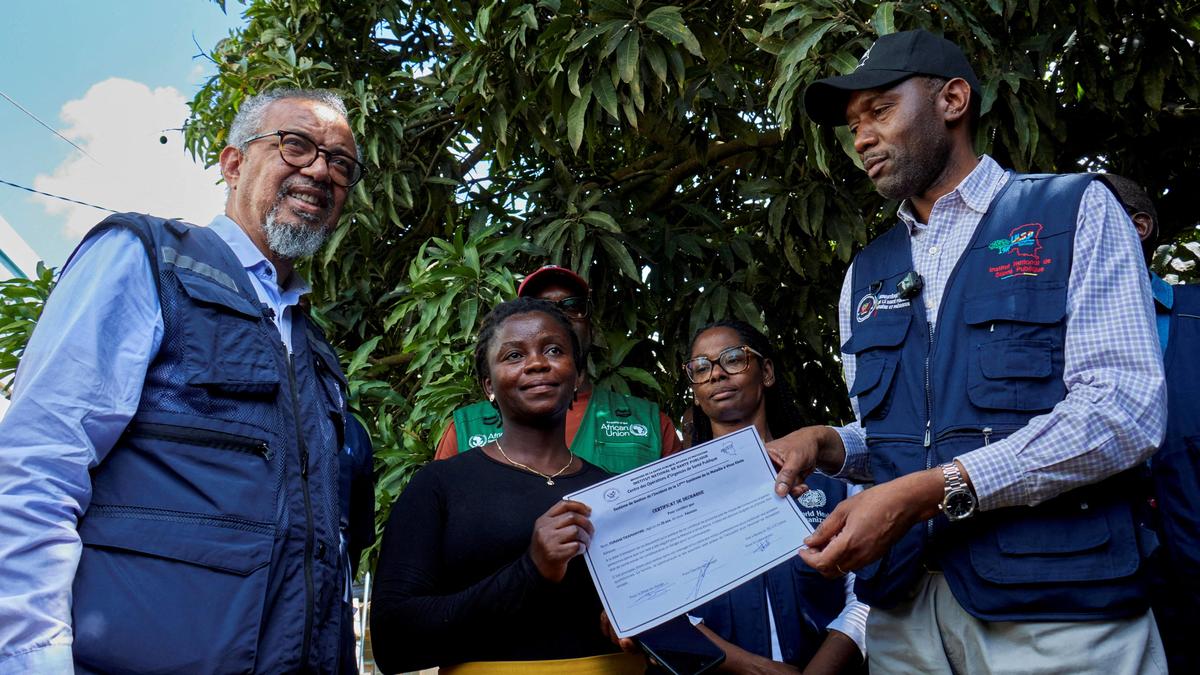
In a meaningful sign that clinical outcomes can be improved even without a licensed treatment, five people have now recovered from Ebola caused by the Bundibugyo strain in the Democratic Republic of Congo. Four nurses who had been receiving care at a hospital in Bunia, the capital of the eastern Congolese province of Ituri, were discharged following their recovery. A laboratory worker had recovered earlier in the week, bringing the cumulative total to five and providing the first concrete evidence that the virus, while serious, is survivable when patients receive timely and adequate medical support.
For the global healthcare community, the recovery of four nurses carries particular significance. Healthcare workers contracting Ebola recoveries during an active outbreak is one of the most damaging dynamics a response effort can face, as it depletes the clinical workforce precisely when it is most needed and creates fear that undermines staff willingness to engage with confirmed or suspected cases. The fact that these nurses survived and were discharged is a critical message for medical teams still operating in the field, reinforcing that protective protocols and supportive care are making a measurable difference even in the absence of specific antiviral treatment.
WHO Director-General Tedros Adhanom Ghebreyesus, visiting Bunia on Saturday, acknowledged directly that there is currently no licensed vaccine or treatment for Ebola caused by the Bundibugyo virus. But he was clear that this does not mean patients are without options. "It is not without hope," he said, noting that the disease can be survived with good medical care. That framing matters for both clinical practice and public communication: it positions supportive care as the active intervention available right now, while reinforcing the urgency of accelerating vaccine and therapeutic development for a strain that has been under-resourced relative to other Ebola variants.
The Bundibugyo strain explained: why this outbreak is medically distinct from previous Ebola crises
The Bundibugyo strain of Ebola is a rarer variant of the virus than the Zaire strain, which drove the catastrophic 2014 to 2016 West Africa outbreak and for which licensed vaccines and therapeutic treatments do now exist. Bundibugyo was first identified in Uganda in 2007 and caused a smaller but significant outbreak at that time. Because the strain is less frequently encountered, it has attracted proportionally less investment in vaccine and treatment research, leaving a significant gap in the global health preparedness toolkit that this current outbreak is now exposing in real time.
The current DRC outbreak is described by the WHO as the 17th in the country and the third-largest since Ebola was discovered five decades ago. That scale alone elevates it from a localised containment challenge to a systemic test of the international health response architecture. The outbreak was declared a public health emergency of international concern by the WHO earlier this month, a designation that triggers enhanced international coordination and resource mobilisation but does not reach the threshold of a pandemic emergency. With 282 confirmed cases and 42 deaths recorded, and 19 new positive test results in the latest reporting cycle, the case count is still climbing.
Jean Kaseya, director-general of the Africa Centres for Disease Control and Prevention, described the situation in blunt terms in a published opinion piece on Sunday, warning that "the risk of regional spread is already happening" and that over 1,100 suspected cases are currently under investigation. That figure, more than three times the confirmed case count, reflects the difficulty of rapidly testing and classifying patients in a resource-constrained outbreak environment and signals that the true scale of the outbreak may be considerably larger than the confirmed numbers suggest. For pharmaceutical companies and health agencies tracking the outbreak, the gap between suspected and confirmed cases is itself a critical data point.
Suspected Ebola cases in Brazil and Italy put international health surveillance systems under immediate pressure
The most significant development from a global healthcare and border surveillance perspective is the emergence of suspected Ebola cases outside Africa. In Brazil, two separate suspected cases were reported in Sao Paulo and Rio de Janeiro over the weekend. In the Sao Paulo case, a man from the DRC presented with a fever after recently visiting the country. In Rio, a patient had recently travelled to Uganda, the second country affected by the current outbreak. Both patients subsequently tested positive for other conditions, meningitis in Sao Paulo and malaria in Rio, but Brazilian health authorities explicitly stated that these alternative diagnoses do not rule out the possibility of Ebola co-infection, meaning both cases remain under active monitoring.
In Italy, emergency Ebola protocols were triggered in Cagliari in Sardinia after a man who had flown back from Congo on Saturday arrived with symptoms. The Italian health ministry confirmed early on Monday that he had tested negative for Ebola and stated that the risk of Ebola in Italy remains very low. While that outcome is reassuring for the immediate situation in Italy, the fact that protocols were activated at all is a meaningful indicator of how seriously European health systems are now treating the risk of importation from the current outbreak zone. It also demonstrates that the international surveillance and screening systems built after the 2014 outbreak are operational and being used.
For the global pharmaceutical and public health community, the appearance of suspected cases in South America and Europe within the same reporting cycle signals that the window for containment within the African region may be narrowing. Travel-linked cases are a predictable feature of any large outbreak in an era of high-volume international air traffic, but each instance outside Africa increases the pressure on health systems worldwide to be prepared for rapid case identification, isolation, and contact tracing in environments that have no established Ebola treatment infrastructure and where clinical teams may have limited direct experience with the disease.
The critical pharmaceutical gap: why no licensed vaccine or treatment exists for Bundibugyo Ebola
The absence of a licensed vaccine or approved therapeutic for the Bundibugyo strain is the central pharmaceutical challenge of this outbreak and the fact that most directly differentiates it from previous Ebola crises that the global health system has confronted. The licensed vaccines that exist, most notably rVSV-ZEBOV (Ervebo), were developed specifically to target the Zaire strain of Ebola and are not effective against Bundibugyo. That strain-specificity means that the vaccine stockpiles and ring vaccination strategies that successfully contained parts of the 2018 to 2020 DRC outbreak cannot be directly applied here, requiring the response to rely entirely on non-pharmaceutical interventions such as isolation, contact tracing, and supportive hospital care.
The pharmaceutical industry and global health funding bodies now face acute pressure to accelerate Bundibugyo-specific vaccine candidates through clinical development. Several experimental candidates have existed in early-stage research pipelines for years but have not advanced to licensure, largely because the low frequency of previous Bundibugyo outbreaks made it difficult to justify the investment required for large-scale clinical trials. The current outbreak, now classified as a public health emergency of international concern, changes that calculus and is likely to trigger new funding commitments from organisations including CEPI, the Coalition for Epidemic Preparedness Innovations, and national health agencies with an interest in outbreak prevention.
In the absence of approved treatments, the clinical management of confirmed cases currently relies on intensive supportive care: fluid replacement, electrolyte management, treatment of secondary infections, and oxygen support. The recovery of five patients, including healthcare workers, under these conditions provides a clinical baseline that will be important for evaluating any experimental therapeutics that may be deployed under compassionate use or emergency protocols as the outbreak continues. Each recovery also generates patient data that contributes to the evidence base researchers need to understand how the Bundibugyo strain progresses and responds to care, filling gaps that have existed since the virus was first identified nearly two decades ago.
What a late and underfunded global response means for outbreak containment timelines
Jean Kaseya's assessment that the outbreak is "outpacing the global response" and that the response "got off to a late start" is a damaging indictment of the international preparedness architecture, particularly given that the WHO declared a public health emergency of international concern only after the outbreak had already reached 282 confirmed cases. The late declaration delays the release of coordinated international resources, the activation of emergency funding mechanisms, and the prioritisation of the outbreak in the agendas of health ministries and pharmaceutical partners. Every week of delay in the early phase of a fast-moving outbreak compounds the difficulty of achieving containment later.
The DRC's specific context makes the response challenge structurally harder than it would be in most settings. The country has experienced 17 Ebola outbreaks, more than any other nation, yet it continues to face severe constraints in laboratory infrastructure, cold chain logistics for any future vaccine deployment, community trust built through previous outbreak responses, and the security conditions needed to allow health workers to operate safely in affected areas. International response partners, including the WHO, MSF, and bilateral donors, are operating in an environment where the logistical baseline is already severely strained before the additional pressures of a rapidly growing case count are added.
For global health policymakers, the pharma sector, and investors watching the outbreak's trajectory, the next four to six weeks are likely to be decisive in determining whether the response can get ahead of transmission chains or whether the outbreak consolidates into a prolonged, geographically spreading emergency. The five recoveries announced this week are a genuine clinical and communications win for the response effort, but they exist within a much larger picture of 282 confirmed cases, more than 1,100 suspected cases under investigation, and a virus strain for which the world has no licensed medical countermeasure ready to deploy at scale.