
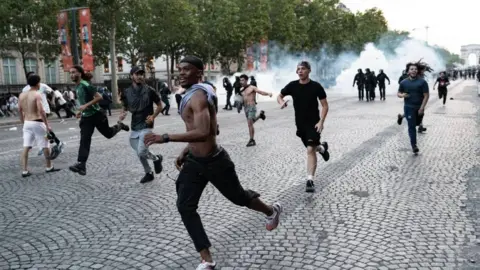
What began as a city-wide celebration of Paris St-Germain's Champions League final victory over Arsenal escalated overnight into one of the most serious public order failures, PSG victory riots France France has seen in years. A total of 219 people were injured in clashes between football fans and police across the country, with eight in serious condition. Interior Minister Laurent Nunez confirmed that 780 people had been arrested in connection with the violence, with more than 450 still in custody at the time of the briefing.
The human cost extended to a fatality. A 24-year-old was found dead near Porte Maillot after an accident on Paris's ring road, which rioters had attempted to block overnight. Witness accounts suggest the man was riding a motorcycle when he struck concrete blocks. A teenager was separately reported to be in critical condition following a brawl in another part of the city. The Paris prosecutor's office confirmed that offences ranged from attacks on police officers and property damage to theft and illegal possession of weapons.
The transport network across Paris bore the operational weight of the crisis, with bus, train and rail services disrupted throughout the night. The Champs-Elysees, which was flooded by fans immediately after PSG's penalty shootout victory, became a focal point for disorder. Footage circulating from the area showed flares being set off, electric bikes burning in the road, and crowds smashing shopfront glass. Police deployed tear gas in the city centre in an effort to push back crowds and restore control of key arterial routes.
How the security response was planned and where it broke down
French authorities had anticipated trouble. The Interior Ministry mobilised thousands of officers ahead of the final, and by Sunday's victory celebrations 6,000 police had been deployed with a specific focus on the Eiffel Tower and the surrounding Champ-de-Mars, where PSG players and staff conducted their victory parade from around 18:00 local time. The scenes at the landmark in the early evening were described as jubilant and largely peaceful, with fans lining the streets as the parade moved through.
The disorder intensified later in the evening and overnight as celebrations in different parts of Paris attracted groups that, according to Interior Minister Nunez, were not genuine PSG supporters. "Other individuals, who are not PSG supporters, who do not even watch the match, come to cause trouble and disturbances," he said, drawing a clear distinction between fans celebrating legitimately and opportunistic actors exploiting the chaos. Paris police alone made 480 arrests, with 277 taken into custody including 82 minors, figures the Paris prosecutor's office described as provisional.
The crisis exposed a recurring vulnerability in France's public order model: the tension between enabling large-scale public celebrations and containing the violent fringe that has attached itself to those events in recent years. Nunez acknowledged the difficulty directly, stating that while the security response would be firm, France also had an obligation to allow freedom of assembly. That balance proved difficult to maintain as the night progressed and disorder spread across multiple districts simultaneously, stretching the resources of even a 6,000-strong deployment.
A recurring crisis: what happened the last time PSG won the Champions League
The violence following this year's final is not an isolated event. France experienced similar unrest when PSG won the same trophy the previous year, with celebrations turning deadly on that occasion as well. That precedent means French authorities entered this cycle aware of the risk, having already committed additional resources and revised crowd management protocols in response to what happened twelve months ago. The fact that the disorder still reached comparable or greater scale raises serious questions about whether the lessons of the previous year were adequately absorbed and acted upon.
The pattern points to a structural problem that goes beyond football. Paris has experienced repeated cycles of large-scale urban unrest linked to sporting events, political protests, and other mass gatherings, each followed by official inquiries, increased deployments, and pledges of firmer responses. The consistency of the outcome suggests that operational adjustments alone are insufficient and that deeper issues around social cohesion, the policing of urban spaces, and the role of opportunistic criminal networks in exploiting celebratory events have not been addressed at a systemic level.
Far-right leader Marine Le Pen used the violence to make a pointed political argument, writing on X that France was the only country where a football club's victory triggered riots and where citizens felt compelled to stay indoors on a night of celebration to avoid confrontation with violence. Her intervention reflects the degree to which recurring post-match disorder has become a politically charged issue in France, feeding broader debates about public safety, immigration, and the capacity of the state to maintain order in its own capital city during high-profile international events.
The economic and reputational damage to Paris from a night of disorder
The immediate economic cost of the riots is visible in the footage: smashed shopfronts along key commercial streets, burned vehicles blocking roads, and a disrupted transport network that affected commuters, businesses, and the hospitality sector during what should have been a peak revenue night. The Champs-Elysees, one of the world's most commercially valuable retail corridors, was a repeated flashpoint, and the images of disorder on a global landmark street will travel internationally in ways that have lasting consequences for Paris's brand as a safe and welcoming city for tourism and major events.
Paris is scheduled to host a series of high-profile international events in the coming years, and the reputational dimension of repeated post-match disorder is significant. Event organisers, sponsors, and international visitors weigh public safety records when making decisions about where to hold major gatherings. A second consecutive year of serious violence following a PSG European triumph will sharpen scrutiny of France's ability to manage the security implications of hosting marquee sporting moments, at a time when the country is still seeking to capitalise on the global visibility generated by recent mega-events it has hosted.
The political fallout is already unfolding alongside the physical damage. President Emmanuel Macron hosted PSG players and staff at the Elysee Palace as part of the official victory celebrations, presenting one image of France to the world while the crisis management operation played out simultaneously across the capital. That split-screen reality, a head of state's reception inside the palace and tear gas outside, captures precisely the reputational contradiction that French authorities will need to confront directly if the country is to avoid a third consecutive year of post-Champions League crisis management.
What the PSG riots reveal about France's wider public order challenge
The events of this weekend are symptoms of a public order challenge that France has been struggling to define clearly for years. Interior Minister Nunez was explicit that the majority of people who came out to celebrate did so peacefully and safely. The violence was driven by a minority who, by official account, were not even present for the football but arrived specifically to cause disorder. That pattern is consistent with what criminologists describe as grievance opportunism: the use of large, emotionally charged public gatherings as cover for acts of violence, looting, and confrontation with security forces that have nothing to do with the event itself.
The presence of 82 minors among those arrested in Paris alone is a data point that crisis analysts will focus on carefully. It signals that the demographic profile of those driving the violence skews young and points to underlying failures in urban social policy, youth engagement, and the conditions in parts of Paris and other French cities where alienation and hostility toward public institutions have become normalised. Deploying more police addresses the symptom but not the cause, and the cycle of violence, arrest, and repeat has demonstrated its own stubborn resilience.
For policymakers, crisis analysts, and city authorities watching from abroad, the Paris riots offer a case study in the limits of security-first responses to complex social disorder. The numbers deployed this year were larger than last year. The arrests were more numerous. The death toll and injury figures were still severe. That gap between resource commitment and outcome is the central question France's government will face in the days and weeks ahead, as the political pressure to produce a different result next time the city celebrates something begins immediately.