
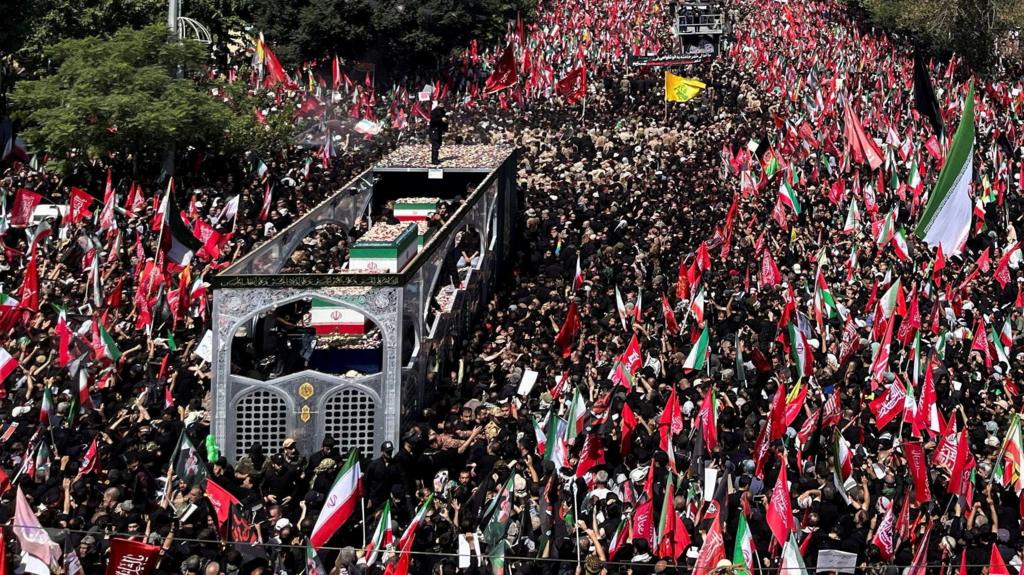
A funeral procession for Iran's former Supreme Leader Ayatollah Ali Khamenei began in Tehran on Monday, drawing vast crowds into the streets of the Iranian capital more than four months after his death in the joint US-Israeli airstrikes that opened the war and fundamentally altered the political landscape of the Middle East. Khamenei, 86, was killed on February 28 in the first wave of strikes on his compound in Tehran, an attack that also killed his daughter-in-law, his one-year-old granddaughter Zahra Mohammadi Golpayegani, and several of the Islamic Republic's most senior officials. The funeral, originally scheduled for March 4, was delayed for months due to the volume of people seeking to attend and the logistical demands of hosting a ceremony of this scale during an active war. Iranian authorities imposed strict security measures and warned of crowd crush risks as thousands gathered along the procession route on Monday morning.
The procession is more than a state funeral. It is a moment of political theatre in the deepest sense: a regime that has been shaken to its foundations by six months of war using the ceremony of farewell to demonstrate continuity, resilience, and the transfer of authority to a new generation of leadership. Iranian state media confirmed Khamenei's death only after initially denying it, in a tearful on-air announcement that declared 40 days of national mourning. President Donald Trump wrote on Truth Social that Khamenei was "one of the most evil people in History" and confirmed the death, while Israeli Prime Minister Benjamin Netanyahu had earlier said there were growing signs that Khamenei was "gone." The manner in which his death was confirmed, denied, then acknowledged, captured the confusion and shock of a regime that lost its founding generation in a single devastating strike.
Khamenei's successor, his son Mojtaba Khamenei, was selected by Iran's Assembly of Experts, the clerical body constitutionally empowered to choose the supreme leader. At 56, Mojtaba is 30 years younger than his father and represents a generational shift in Iranian leadership that carries direct implications for how the regime navigates the post-war period, its ongoing nuclear negotiations, and its relationships with regional and global powers who are watching Tehran's new face with a combination of strategic calculation and cautious curiosity.
How the February 28 Strikes Killed Khamenei and Decapitated the Islamic Republic's Leadership Structure
The strikes that killed Khamenei on February 28 were the opening move of a conflict that the US and Israel had clearly planned as a decapitation operation targeting not just military infrastructure but the political command structure of the Islamic Republic itself. Satellite imagery released after the strikes showed significant damage to Khamenei's compound in Tehran, and the deaths of multiple senior officials alongside the supreme leader confirmed that the strikes had achieved a level of political disruption that went well beyond conventional military targeting. The loss of figures across the regime's security, political, and clerical hierarchy in a single operation created a leadership vacuum that Iran's institutions were forced to fill under wartime conditions and without the deliberative processes that succession in the Islamic Republic normally involves.
Mojtaba Khamenei's selection by the Assembly of Experts as the new supreme leader represented the fastest and most consequential clerical appointment in the history of the Islamic Republic. Reports indicated that Mojtaba had been injured in the initial strikes and had not been seen publicly since the war began, adding uncertainty to the early weeks of his tenure that has only partially resolved as the months have passed. The generation that founded the 1979 revolution and constructed the ideological and institutional architecture of the Islamic Republic was effectively eliminated in the opening phase of the war, leaving a leadership cohort that includes 71-year-old President Masoud Pezeshkian, parliamentary speaker and chief negotiator Mohammad Bagher Ghalibaf in his 60s, and Revolutionary Guard commander Ahmad Vahidi, also in his 60s. The average age of Iran's functional decision-makers has dropped sharply, and with it, some analysts argue, the ideological rigidity that defined the founding generation.
Vali Nasr, professor of International Affairs and Middle East Studies at Johns Hopkins' School of Advanced International Studies, offered the most pointed analytical framing of this generational shift. The new leadership is not made up of the sort of people Washington has historically described as "woolly-brained apocalyptic ideologues," Nasr said, a characterisation that suggests the post-war Iranian leadership may be more pragmatic, more transactional, and more open to the kind of negotiated settlements that the founding generation's ideological commitments made structurally difficult. Whether that analytical assessment translates into actual policy flexibility in the nuclear negotiations and the broader US-Iran relationship is the central question that the funeral procession's global audience of foreign ministries, intelligence services, and strategic analysts is attempting to answer.
What Iran's New Leadership Must Navigate and Why This Political Moment Is Both Fragile and Consequential
The procession under way in Tehran on Monday takes place against a backdrop of what the BBC's chief international correspondent Lyse Doucet, reporting from the Iranian capital under conditions that restrict use of her material on the BBC's Persian Service, described as a country in the midst of profound change. Iran has absorbed six months of war, the deaths of its supreme leader and multiple senior officials, the selection of a new supreme leader under emergency conditions, and the sustained pressure of military operations that have tested the Revolutionary Guard's capabilities and the regime's capacity to maintain internal order simultaneously. That it has survived those pressures intact as an institutional structure is itself a political fact of significance, and the funeral procession, with its vast crowds and official security apparatus, is designed to communicate that the Islamic Republic has not merely survived but retained the capacity to mobilise public expression of loyalty at scale.
The new leadership's core challenge is translating survival into legitimacy at a moment when the old guard's sources of authority, revolutionary credentials, ideological continuity, and charismatic individual figures, have been physically removed. Mojtaba Khamenei inherits a supreme leadership position under conditions his father never faced: an active war, a damaged economy under sustained sanctions, a population that has repeatedly demonstrated its willingness to protest against the regime in recent years, and an international community assessing whether the new faces represent genuine strategic change or cosmetic continuity. The question Nasr posed, whether Iran's new leadership can capitalise on this potentially fleeting opportunity to rebuild the regime's shattered legitimacy, is the one that will define the Islamic Republic's trajectory for the next decade.
The global political implications of Iran's leadership transition extend into the negotiations that both sides have been conducting around a potential deal to end the war and address the nuclear question. Ghalibaf's dual role as parliamentary speaker and chief negotiator places him at the centre of the most consequential diplomatic process in the region, and his profile as a pragmatic political operator rather than a revolutionary ideologue may create more diplomatic space than existed under the previous leadership structure. Washington, which assassinated the previous supreme leader as a war aim, must now decide how to engage with a Tehran whose new faces were described by one of America's leading regional scholars as a departure from the ideological archetype that framed decades of US-Iran hostility. The funeral of Ayatollah Ali Khamenei is therefore simultaneously a moment of mourning for those loyal to the Islamic Republic, a display of institutional resilience for the regime, and a marker of a genuinely new phase in one of the world's most consequential geopolitical relationships.