
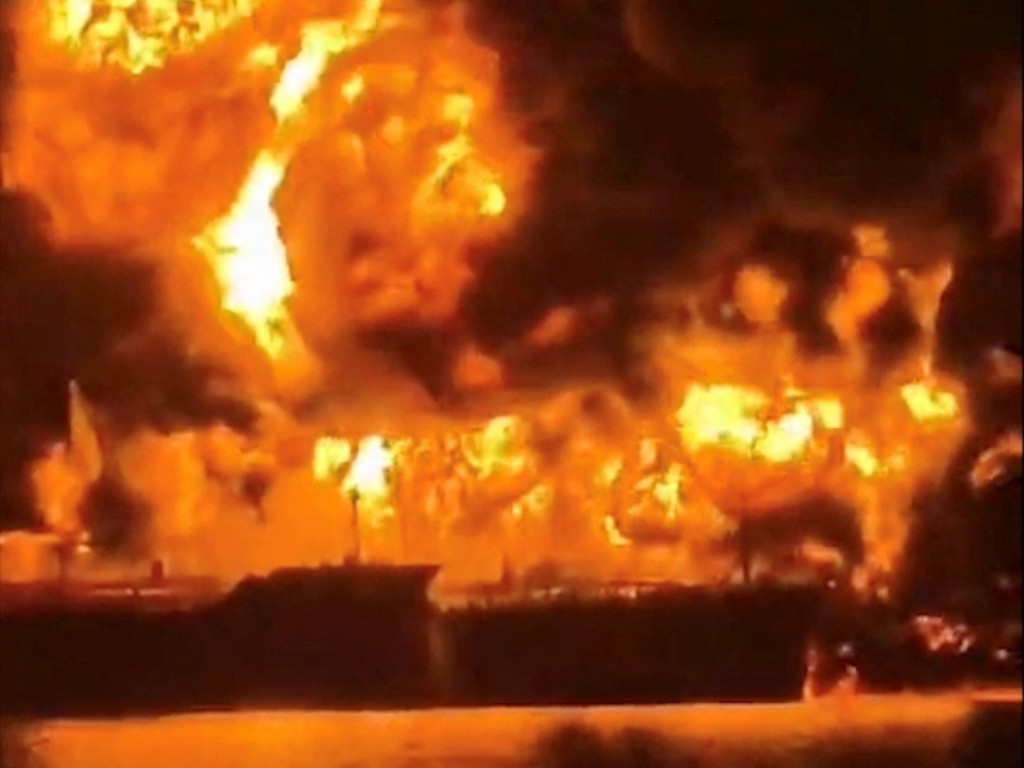
Two oil tankers burn near Iraq erupted in massive fireballs in Iraqi waters on Thursday night, marking one of the most alarming escalations since the United States and Israel launched military operations against Iran two weeks ago. The attacks came just hours after President Donald Trump told a rally audience that America had already won the war, a claim that the burning ships and fresh drone strikes appeared to directly contradict.
Images verified by Reuters, filmed from the shores of Basra port, showed the vessels consumed by towering orange flames that lit up the night sky. Iraqi authorities confirmed that Iranian boats loaded with explosives had carried out the overnight attacks, and at least one crew member was reported killed in the violence.
The strikes on the Iraqi tankers followed a series of earlier attacks the same day. Three ships were hit in the Gulf, with Iran's Revolutionary Guards publicly claiming responsibility for at least one of them, a Thai bulk carrier they said had defied their orders. A separate container vessel also reported being struck by an unknown projectile near the United Arab Emirates, according to maritime security authorities.
Global Energy Supplies Face Worst Disruption Since the 1970s Oil Shocks
The ongoing conflict, which has already claimed roughly 2,000 lives, has triggered the most severe disruption to global energy supplies in more than five decades. Oil prices that had briefly retreated earlier in the week after Trump suggested the war would soon end surged back above 100 dollars a barrel on Thursday following the fresh wave of attacks. Iran has vowed to block all oil traffic through the Strait of Hormuz until American and Israeli strikes on its territory stop completely.
The Strait of Hormuz, the narrow waterway running along the Iranian coast, handles a significant portion of the world's oil trade. Tehran has made clear it will not engage in any negotiations with Washington while the attacks continue. Drones were reported flying into Kuwait, Iraq, the UAE, Bahrain, and Oman on Thursday, signaling that Iran's capacity for long-range strikes remains far more intact than U.S. and Israeli officials had claimed.
In a sign of how seriously financial institutions are taking the threat, Citibank announced it would temporarily close its branches in the UAE after Iran declared banks legitimate military targets and warned residents to stay at least one thousand meters away from them. HSBC followed by shutting its branches in Qatar. ING analysts stated plainly that the only path to lower sustained oil prices runs through reopening the Strait of Hormuz, warning that market highs may still lie ahead.
Strategic Reserve Release Fails to Calm Markets as Prices Blast Past $100
In an attempt to ease the pressure, developed nations announced on Wednesday the largest coordinated release of strategic oil reserves in history, totaling 400 million barrels with nearly half coming from the United States alone. Trump said the move would substantially reduce oil prices and help bring the crisis to a close. But markets responded with skepticism, and analysts noted the release would cover just three weeks of supply normally flowing through the blocked strait.
Tony Sycamore, an analyst at IG, described the tanker attacks in Iraq as a direct and forceful Iranian response to the reserves announcement. Iran also struck fuel storage tanks in Bahrain and hit oil facilities at Oman's Salalah port with drones. Saudi Arabia confirmed it had intercepted several drones heading toward its Shaybah oilfield, suggesting Iran is attempting to draw the entire Gulf region into the economic pressure campaign.
Iran's military command spokesperson raised the stakes further on Wednesday, telling the world to prepare for oil prices of 200 dollars a barrel. That figure would shatter the all-time record of 147 dollars set in July 2008, just weeks before the global financial crisis began. While many analysts view the 200-dollar figure as a negotiating threat rather than a near-term forecast, the direction of travel in oil markets has so far matched Tehran's narrative more than Washington's.
Trump Claims Victory While U.S. Intelligence Paints a Different Picture
Speaking at a campaign-style rally in Hebron, Kentucky, on Wednesday, Trump told the crowd that the United States had virtually destroyed Iran and that the war was essentially over within its first hour. The remarks were intended to reassure Republican voters ahead of a congressional election later this year, but they sat uneasily alongside the intelligence picture emerging from inside the administration. Three sources familiar with the matter told Reuters that U.S. intelligence assessed Iran's leadership as largely intact and not at risk of imminent collapse.
The stated military objectives of the U.S.-Israeli campaign have included destroying Iran's missile capabilities and nuclear program. Trump has gone further, demanding Iran's unconditional surrender and the right to determine its future leadership. But without a clear plan to reopen the Strait of Hormuz or bring Iran to the negotiating table, the gap between Trump's public declarations of victory and the reality on the ground has grown visibly wider with each new attack.
Iran has communicated its strategy with unusual directness over the past several days. Rather than seeking a quick resolution, Tehran appears to be playing a longer game, banking on rising oil prices and economic pain in Western countries to erode political support for the war. Iranian officials have ruled out talks with Washington entirely for as long as strikes continue, leaving diplomats with little visible pathway toward de-escalation in the near term.