
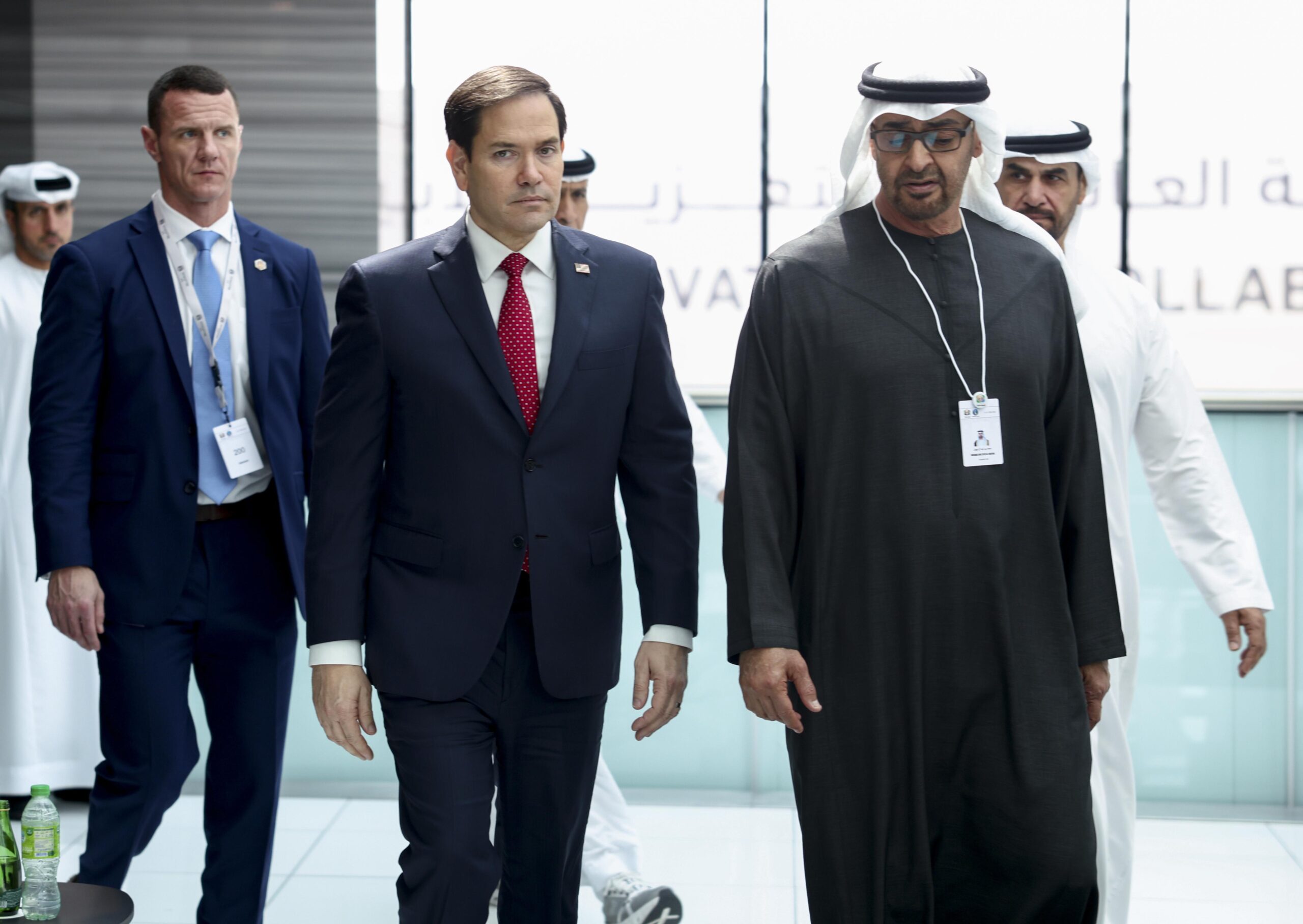
US Secretary of State Marco Rubio landed in Abu Dhabi late on Tuesday for the first high-level American diplomatic mission to the Gulf since the signing of a preliminary accord to end the four-month US-Israeli war with Iran. The visit is Rubio's most significant test since the deal was announced, because the allies he is meeting, the Rubio visits UAE and Kuwait, are not passive observers of the agreement. They are countries that were struck by Iranian missiles, suffered civilian casualties, and are now being asked to accept a deal that their leaders view as more favourable to Tehran than the damage Iran caused would seem to warrant.
Rubio held a working lunch in Abu Dhabi with UAE President Sheikh Mohammed bin Zayed Al Nahyan alongside National Security Advisor Sheikh Tahnoun bin Zayed Al Nahyan and Foreign Minister Sheikh Abdullah bin Zayed Al Nahyan, a senior meeting format that signals the UAE's seriousness about the concerns it intends to raise. Asked on arrival whether he planned to address Gulf allies' unease with the accord, Rubio told reporters: "That most certainly will come up in these discussions," an acknowledgment that the diplomatic discomfort is real and cannot simply be managed with reassuring language from Washington.
The trade and diplomatic stakes of this tour extend well beyond the bilateral US-Gulf relationship. Both the UAE and Kuwait host strategic US military bases that were central to the war effort against Iran, making their continued confidence in American security commitments operationally important rather than just symbolically significant. If Gulf allies conclude that the United States negotiated a deal that protects Iran's future capacity to threaten them while offering Iran a $300 billion reconstruction fund, the damage to Washington's credibility as a reliable security partner in the region would have lasting consequences for trade, investment, and the basing arrangements that underpin US military reach across the Middle East.
Why Gulf states are alarmed by the $300 billion reconstruction fund and the deal's silence on Iranian ballistic missiles
Gulf states' deepest concern about the Iran deal centres on two specific gaps that the 14-point interim accord does not address: the proposed $300 billion reconstruction fund for Iran and the complete absence of any provisions restricting Tehran's ballistic missile programme. US regional allies fear that reconstruction money flowing to Iran could be redirected to rebuild the military capabilities that struck them during the war, a concern grounded in Iran's past behaviour of channelling economic resources toward military and proxy network expansion rather than civilian reconstruction.
The ballistic missile issue is arguably even more acute from a Gulf security perspective. Every Gulf state that was struck by Iranian missiles and drones during the conflict has an immediate and tangible interest in seeing Iran's strike capacity reduced or constrained as part of any lasting peace arrangement. The interim accord's silence on this point leaves the threat architecture that enabled those attacks entirely intact. For countries that suffered civilian deaths from Iranian missile strikes, accepting a deal that preserves Iran's ability to repeat those attacks while providing it with hundreds of billions in reconstruction finance requires a level of strategic trust in US security guarantees that Gulf leaders have not yet publicly confirmed they hold.
The covert dimension adds another layer of concern. Reuters reported last week that Iran established secretive new cells in Iraq to carry out attacks on Gulf countries including Kuwait, the UAE, and Saudi Arabia, with at least seven drone attacks against sites across those three countries recorded during roughly a one-month period in April and May. Those attacks occurred while the war was still technically ongoing, but the fact that Iran was simultaneously building new covert operational infrastructure in Iraq during the period that led to the peace deal raises pointed questions about whether Tehran's strategic intentions align with the diplomatic language it is now presenting in negotiations.
How the UAE's economic model was damaged by the war and what the deal means for its recovery
The UAE faces distinctive economic consequences from the war that go beyond the physical damage caused by Iranian missile strikes. The country's non-oil economy is built on its reputation as a stable global financial hub in a volatile region, a brand proposition that depends on international businesses and expatriate workers feeling confident enough to locate there. The war caused a significant number of expatriates, who form the core of the UAE's non-oil workforce and consumer base, to temporarily or permanently relocate, inflicting direct damage on the service sector, real estate market, and financial industry that Abu Dhabi has spent decades constructing.
For UAE trade and investment recovery, the Iran deal is therefore a double-edged diplomatic development. A genuine and durable peace that credibly reduces the threat of future Iranian strikes would support the return of expatriate confidence and accelerate the economic normalisation the UAE needs. But a deal that leaves Iran's missile capacity intact, funds its reconstruction generously, and fails to address the covert attack networks it built in Iraq during the war is not a reliable foundation for the kind of long-term stability the UAE's economic model requires. Gulf leaders want peace, but they want a peace that actually removes the threat, not one that simply pauses it.
Tehran has made a pointed observation in response to Gulf complaints about the deal's terms. Iran has noted publicly that Gulf states made various logistical accommodations for the US war effort, including hosting the military bases from which operations against Iran were conducted, while simultaneously expressing discomfort about being targeted in the conflict. That observation is a diplomatic reminder that Gulf states' position during the war was not neutral, and it is Tehran's way of signalling that it views Gulf discomfort with the deal's terms as the political cost of having facilitated the conflict, rather than a legitimate grievance that should reshape the agreement's substance.
What Rubio's role in the deal reveals about US internal politics and the 2028 Republican succession race
Marco Rubio's diplomatic mission to the Gulf carries a political dimension that extends beyond the immediate substance of the Iran negotiations. America's Secretary of State was notably absent from the Iran-related talks that Vice-President JD Vance led in Switzerland over the weekend, a division of diplomatic labour that reflects something more than scheduling logistics. Rubio and Vance are both widely viewed within Republican Party circles as potential candidates to succeed Trump, and party insiders frequently cast the contest as a two-way race between them, making every high-profile diplomatic assignment a moment of comparative evaluation.
Rubio's assignment to the Gulf reassurance mission is politically delicate precisely because of his own history. He was known before his current role as a hawkish critic of Iran, a position that resonated strongly with Gulf partners who share that instinct but now find him defending a deal that many congressional Republicans have publicly described as capitulation. He needs to defend a deal that Trump firmly supports without alienating either the Gulf allies who find it insufficient or the Republican base that views Iran with deep suspicion. Threading that needle successfully would be a significant diplomatic and political accomplishment; failing to do so would raise questions about whether his loyalty to the Trump deal comes at the cost of his own credibility on Iran.
The IAEA dimension adds a technical but consequential layer to Rubio's Gulf mission. IAEA Director-General Rafael Grossi confirmed on Wednesday that nuclear inspections in Iran would proceed following the interim accord but said the modalities have not yet been finalised, an unresolved detail that matters enormously for the deal's credibility. Iran's enriched uranium stockpile, which includes material enriched to up to 60 percent purity, sits a short technical step from weapons-grade material at roughly 90 percent. Until the inspection framework is formally agreed and operational, Gulf states have no independent verification mechanism for the nuclear commitments Washington is presenting as one of the deal's central achievements, and Rubio will be pressed on that gap during every meeting of his three-day tour.