
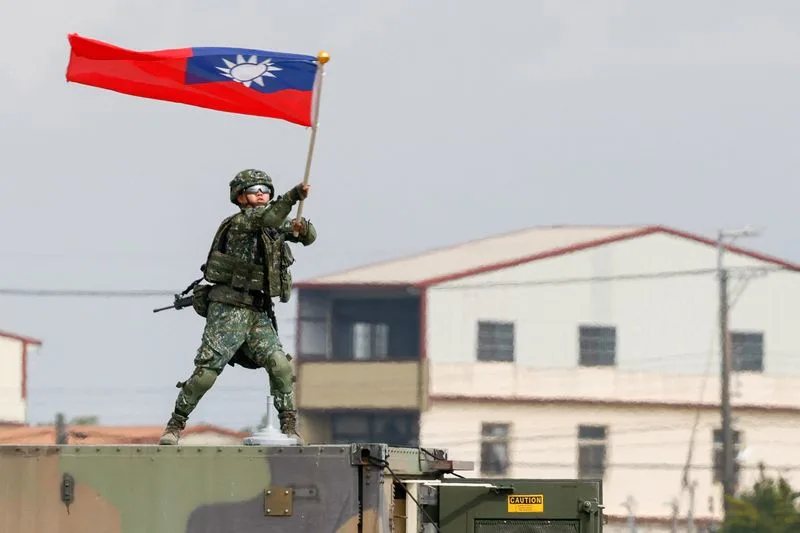
Taiwan will conduct its most operationally realistic war games in the island's defence history during the annual Taiwan Han Kuang exercises from August 5 to 14, testing for the first time the wartime relocation of arms production lines from vulnerable fixed facilities to dispersed and hardened alternative sites, the conversion of civilian factories for military production under emergency orders, and the deliberate slowing of mobile internet speeds to simulate the bandwidth scarcity that a Chinese cyber and electronic warfare campaign would impose during any invasion attempt. The exercises, whose planning outline was presented by Major General Lu Wen-yuan, head of the Joint Operations Division, reflect Taiwan's evolving understanding of how a Chinese attack would be designed to paralyze the specific industrial, logistical, and communications infrastructure whose preservation is most critical to sustaining combat operations beyond the initial strike phase.
The specific scenario that the Han Kuong 2026 exercises simulate is operationally significant and reflects the direct lessons of Taiwan's study of how China has conducted its recent military exercises in ways that blur the line between training and operational preparation.
"Chinese forces use routine annual joint military exercises as cover for large-scale landing training, concealing plans to attack Taiwan while completing final assault preparations," Major General Lu told reporters at a press briefing.
This scenario, in which a routine PLA exercise transitions without announcement into the initial phase of a full invasion, is precisely the contingency that most exercises in most countries would acknowledge as a theoretical possibility but whose simulation requires the specific institutional willingness to treat a peacetime training event as if it has become a combat emergency, activating the emergency orders, production relocations, and rapid response mobilizations that the scenario demands in real time rather than as a scripted tabletop exercise. Taiwan's decision to simulate this specific scenario, and to test the specific response of relocating the 202nd Arsenal and mobilising civilian factories under emergency orders, documents an institutional seriousness about its military preparedness whose realism the exercises are designed to measure and expose for correction.
The drills come in the specific context of Taiwan's reported sharp rise in Chinese coast guard activity around the island, heightening concerns in Taipei that Beijing could escalate pressure off Taiwan's Pacific coast and threaten the vital supply routes whose protection the naval and coast guard joint drills with live troops, equipment, and ammunition are designed to test. The coast guard activity increase is the specific real-world threat environment whose escalation the Han Kuang exercises are responding to, connecting the exercise's simulated scenarios to the observable operational pressure that Taiwan's security community is managing in the weeks before the exercises begin.
The Han Kuang Announcement and What Makes 2026 Different
Taiwan's annual Han Kuang exercises have been conducted since the 1980s, evolving progressively from scripted set-piece exercises toward the increasingly realistic and demanding tests of actual military capability that the 2026 announcement describes. The specific additions to this year's exercises that distinguish them from previous iterations reflect the specific lessons that Taiwan's defense planners have drawn from the Ukraine conflict's documentation of how modern warfare attacks the economic and industrial infrastructure that sustains military operations, from the Iran war's demonstration of how civilian infrastructure targeting creates the cascading incapacitation effects that undermine a defender's ability to sustain organised resistance, and from Taiwan's own Nantou County resilience exercise in June that Global Repute News reported on, which tested the compound crisis scenarios including infrastructure attacks, information warfare, and civilian factory mobilisation.
The 202nd Arsenal relocation test is the single most operationally significant element of the Han Kuang 2026 announcement. The Armaments Bureau's 202nd Arsenal in Taipei is one of Taiwan's primary military production facilities, and its location in the capital city makes it one of the highest-priority targets in any Chinese strike campaign designed to paralyze Taiwan's ability to sustain combat operations beyond the initial ammunition and equipment reserves that pre-positioned military stocks provide. A defender whose only weapons production facility is a fixed urban site that can be destroyed in the conflict's opening strikes is in a fundamentally different strategic position than a defender who has demonstrated the ability to disperse production to multiple hardened sites whose discovery and simultaneous destruction is operationally difficult for any attacking force.
The civilian factory conversion test addresses the specific strategic resilience gap that fixed military production facilities' vulnerability creates. A Taiwan that can convert civilian manufacturing infrastructure to military production under emergency orders is a Taiwan whose industrial resilience cannot be paralyzed by the destruction of its dedicated military production sites, because the conversion-capable civilian manufacturing base provides the distributed and redundant production capacity whose existence the Chinese strike planners would need to account for and whose elimination would require targeting virtually all manufacturing infrastructure rather than only the identifiable military production sites whose location Chinese intelligence has presumably mapped in detail.
The deliberate internet slowdown, described as the first time this specific test has been conducted, reflects Taiwan's assessment that China's cyber and electronic warfare capabilities would impose exactly this bandwidth restriction as an early phase of any invasion campaign, degrading communications, slowing emergency response coordination, and creating the information vacuum that both sides in any conflict would seek to exploit for operational advantage. Testing how citizens and institutions communicate when bandwidth becomes scarce, and identifying the specific critical communications whose preservation requires satellite, hardened landline, or mesh network alternatives, provides the vulnerability assessment whose findings can inform the infrastructure investment and civilian preparedness measures that reduce the communication degradation's impact.
The Four Strategic Lessons Driving Taiwan's 2026 Exercise Design
The specific elements of the Han Kuang 2026 exercises reflect four distinct strategic lessons whose accumulation in Taiwan's defense planning community has produced the exercise design that Major General Lu outlined.
Lesson One: Fixed military production facilities are first-strike targets.
The Ukraine conflict documented extensively how Russian strikes systematically targeted Ukrainian defence industry facilities in the conflict's early phases, attempting to degrade the production capacity whose sustenance is necessary for a defense that continues beyond the initial weeks of combat. Taiwan's geography makes this targeting strategy particularly attractive for Chinese planners, because the island's small land area means that Chinese long-range precision strike systems can reach every point on the island's surface, and its defence industry's concentration in identifiable fixed facilities makes production paralysis achievable if Taiwan cannot disperse those facilities before or immediately after an attack begins.
Lesson Two: The transition from peacetime to wartime is too slow in traditional military models.
The scenario that Major General Lu described, in which a Chinese exercise transitions without announcement into an initial invasion phase, is the specific operational problem whose management requires Taiwan's armed forces to maintain readiness at a level that allows immediate combat response without the mobilization period that traditional military models assume is available before hostilities begin. An army that needs 48 hours to raise its combat readiness from normal peacetime operations to full combat posture faces a catastrophic disadvantage against an adversary that uses a peacetime exercise as cover for the attack's initial phase, because the transition time is precisely what the attacker's deception is designed to deny.
Lesson Three: Economic and industrial resilience is a military capability.
The Iran war's experience, whose inclusion in Taiwan's planning context Global Repute News's June reporting on the Nantou exercise documented through the reference to lessons from wars in Ukraine and the Middle East, demonstrated that sustained conflict between modern states is ultimately an industrial contest in which the side that can maintain production of the munitions, equipment, and supplies that combat operations consume has the fundamental military advantage over the side whose production is paralyzed by the opponent's strikes. Taiwan's investment in testing civilian factory conversion reflects the understanding that the military-industrial mobilization whose activation is the functional difference between a defense that can be sustained and one that collapses within weeks is a critical security capability whose preparedness requires the same exercise testing as conventional military manoeuvre.
Lesson Four: Communications resilience must be tested under realistic degradation conditions.
The deliberate internet slowdown, whose discomfort for the Taiwanese public who will experience reduced mobile bandwidth for 10 days is real and intentional rather than simulated and theoretical, reflects the specific testing philosophy that has characterized Taiwan's more realistic recent exercises: that a resilience exercise which does not impose real discomfort on real people in real conditions is testing a simulation rather than actual capability. Citizens who have experienced communication bandwidth scarcity in a non-emergency context have the specific experiential knowledge that allows them to develop the workarounds, alternative communication methods, and information triage priorities that the emergency itself would demand without the panic that encountering the degradation for the first time under fire would produce.
How Taiwan's Defence Exercises Have Evolved Toward Greater Realism
1980s: Han Kuang exercises established as annual war games for Taiwan's armed forces. Initial exercises focus on conventional military maneuver and combined arms operations reflecting the threat assessments of the Cold War era's conventional military balance across the Taiwan Strait.
2000s to 2010s: Han Kuang exercises progressively incorporate more realistic scenarios reflecting the PLA's growing missile, air, and naval capabilities, including strike on critical infrastructure scenarios, amphibious assault defense, and urban combat elements that previous exercises had addressed less directly.
2022: Ukraine conflict begins, providing the most directly relevant contemporary evidence for how a modern military conflict attacks economic and industrial infrastructure as a deliberate strategic campaign rather than as collateral to conventional military operations. Taiwan's defense planners begin incorporating Ukraine lessons systematically.
2024: Han Kuang exercises incorporate more demanding civilian-military integration elements, reflecting the assessment that Taiwan's defense requires the mobilization of civilian infrastructure, population, and economic capacity rather than purely military force.
June 2026: Nantou County resilience exercise tested compound invasion scenarios including infrastructure attacks, information warfare, and civilian factory mobilization for more than 370 officials, providing the specific local government and civilian institutional readiness assessment whose lessons feed into the Han Kuang exercise design.
July 2026: Han Kuang 2026 exercise announcement reveals the arms factory relocation, civilian industrial conversion, and deliberate internet slowdown elements that make this the most operationally realistic exercise in the series' history.
August 5 to 14, 2026: Han Kuang exercises conducted across Taiwan, including live ammunition naval drills for sea lane protection, 202nd Arsenal wartime relocation simulation, civilian factory emergency conversion testing, and 10 days of deliberately reduced mobile internet bandwidth.
What the Exercise Signals to Beijing, Washington, and Taipei's Own Public
The political communication of Taiwan's Han Kuang exercises operates simultaneously across three audiences whose very different interpretive frameworks give the same military exercises distinct political meanings.
For Beijing, the exercises' specific focus on surviving a first strike that parallelizes fixed military production facilities and disrupting communications is a direct response to the PLA's own strike planning assumptions, communicating that Taiwan's defense planners understand how a Chinese attack would be designed and are taking specific measures to reduce the effectiveness of those design assumptions. The civilian factory conversion element is particularly challenging for Chinese military planning because it disperses the production target set beyond the identifiable fixed military facilities whose locations PLA strike planning has presumably developed in detail, requiring Chinese planners to either expand their strike target list to include civilian manufacturing infrastructure or accept that Taiwan's military production capacity cannot be parallelized by strikes on the facilities they have mapped.
For Washington, whose strategic commitment to Taiwan's defense under the Taiwan Relations Act is the specific relationship that Beijing's military pressure is designed to test, the exercises demonstrate exactly the kind of military self-sufficiency development that American strategic advisers and congressional supporters of Taiwan have been urging Taipei to demonstrate. A Taiwan that can sustain its own defence beyond the initial weeks of combat through industrial resilience and dispersed production is a Taiwan whose defence the United States can support through the supply of critical materials rather than needing to intervene directly to prevent immediate military collapse, reducing the specific trigger conditions for direct US military involvement that China's invasion planning must account for.
For Taiwan's own public, the deliberate internet slowdown is the exercise element whose political management is most delicate. Taiwanese citizens who experience 10 days of reduced mobile internet bandwidth will either respond with the civic engagement that resilience exercises require, understanding the bandwidth restriction as a necessary test of emergency communication capability, or with the frustration and political pushback that any government-imposed communication restriction generates regardless of the exercise rationale. The political management of public communication about why the bandwidth is being reduced, what it is testing, and how long it will last is the specific domestic political challenge whose success or failure will determine whether the internet slowdown achieves its testing purpose or becomes a political controversy that overshadows the exercise's military achievements.
What Civilian Factory Military Conversion Means for Taiwan's Industries
The civilian factory mobilization element of the Han Kuang 2026 exercises has direct economic implications for the Taiwanese businesses whose facilities would be requisitioned for military production in the emergency scenario the exercises simulate. Taiwan's manufacturing sector, which includes some of the world's most sophisticated semiconductor fabrication, precision engineering, and electronics assembly operations, represents a dual-use industrial base whose wartime conversion for military production is both the most valuable potential reserve capacity and the most economically significant potential disruption to the global supply chains that Taiwan's civilian production serves.
The semiconductor dimension of Taiwan's industrial mobilization is the most globally significant element of this calculation, because Taiwan's dominance in advanced chip manufacturing, exercised primarily through TSMC and the broader semiconductor ecosystem centered on the Hsinchu Science Park, means that any wartime conversion of semiconductor facilities to military production, or any damage to those facilities in a Chinese attack, would remove from global availability the specific chip production whose absence would cascade through the global technology supply chains that depend on Taiwan-produced semiconductors for products ranging from consumer electronics to automotive systems to defense equipment.
The economic planning for civilian factory military conversion requires Taiwan's government to engage with its industrial sector on the specific emergency requisition frameworks, compensation arrangements, and conversion logistics whose clarity in advance is the prerequisite for a rapid conversion response in an actual emergency. Businesses whose facilities might be requisitioned for military production need to understand what compensation they would receive, what liability protections would apply to their employees during military production operations, and what their rights are regarding post-conflict restoration of their civilian production capacity, questions whose resolution in advance is both economically necessary for business planning and politically necessary for maintaining the civilian cooperation that voluntary industrial mobilization requires in a democracy.
What Taiwan's Exercise Design Teaches About 21st Century Small Power Defense
Taiwan's Han Kuang 2026 exercise design is being watched by defense analysts and military planners across the world's small and medium powers whose threat environments include the possibility of a larger adversary's military attack, as a case study in how a technologically sophisticated democratic nation adapts its defense strategy to the specific challenge of countering a larger adversary's strike campaign against the economic and industrial infrastructure that sustains military operations.
The three specific innovations that make Han Kuang 2026 globally significant as a defense planning model are its simultaneous testing of arms production dispersal, civilian industrial conversion, and communication degradation resilience. Together, these elements address the specific strategy that larger adversaries have developed for defeating smaller ones not through conventional military superiority in direct combat, but through systematic paralysis of the economic, industrial, and communications infrastructure that translates military force potential into actual combat capability. A small power that can sustain its own production, convert civilian industry to military use, and communicate effectively under degraded bandwidth conditions is a fundamentally more resilient defender than one whose military capability exists only in its pre-conflict stockpiles and whose sustainability ends when those stockpiles are depleted.
The Ukraine conflict's most important lesson for small power defense, that the ability to sustain production of artillery shells, armored vehicles, and electronic warfare systems is as militarily important as the ability to operate them effectively in combat, is the specific strategic insight that Taiwan's exercise design is operationalizing. The civilian factory conversion element is Taiwan's specific application of this lesson to its own industrial base, adapting the general principle to the specific characteristics of a technologically sophisticated manufacturing economy whose precision engineering and electronics capabilities make it a more flexible military production resource than a purely heavy industry base would be.
What Defense Specialists Say About Taiwan's Wartime Industrial Strategy
Defense analysts who have studied Taiwan's evolving military strategy have consistently identified industrial mobilization as the critical missing element in previous iterations of Taiwan's defense planning, whose focus on conventional military hardware acquisition, force training, and operational concept development did not adequately address the sustainability dimension that a conflict lasting more than weeks or months would require.
The specific assessment that Taiwan's pre-conflict military stockpiles are insufficient to sustain high-intensity combat operations beyond approximately two to four weeks without resupply has been a persistent finding in independent military assessments of Taiwan's defense capacity, creating the specific strategic vulnerability that both the Nantou County exercise and the Han Kuang 2026 design are addressing through the industrial mobilization and production dispersal elements that transform stockpile sustainability from a terminal constraint into a logistical management challenge.
The coast guard joint drills with live troops, equipment, and ammunition for sea lane protection reflect the specific resupply dimension that stockpile sustainability and civilian industrial conversion both ultimately depend on, because a civilian factory producing military components is strategically useless if the sea lanes that supply its raw materials and the distribution routes that move its finished products to where they are needed cannot be protected. The naval-coast guard coordination that the sea lane protection exercises test is therefore not a separate military capability but the logistics enabler that makes industrial mobilization militarily effective rather than economically interesting but operationally irrelevant.
The August Exercises and What Their Results Will Reveal
The Han Kuang exercises from August 5 to 14 will generate the specific performance data on arms production relocation logistics, civilian factory conversion timelines, internet slowdown communication adaptation, and sea lane protection coordination that Taiwan's defense planners need to identify the gaps between planned and actual capability whose correction is the exercise's primary institutional purpose.
The 202nd Arsenal relocation simulation's most revealing metric will be the time required to complete the dispersal of production lines from their Taipei location to alternative sites, and the production rate that the dispersed configuration achieves relative to the pre-dispersal baseline. A relocation that takes longer than the operational timeline between a Chinese exercise transition to actual attack and the first PLA strike hitting the 202nd Arsenal's Taipei location is a relocation that cannot be completed in time to preserve production capacity, making the relocation speed the specific performance standard that the exercise must measure honestly.
The civilian factory conversion timeline, from emergency order issuance to the first military component coming off a converted civilian production line, is the operational metric that determines whether the conversion concept is militarily useful on the timescales that a conflict's opening phases impose. A conversion that requires months of preparation after an emergency order is issued provides strategic depth for a prolonged conflict but limited value for the immediate crisis management of the conflict's opening weeks.
The internet slowdown's public response will generate the social and political data about civilian communication resilience that is harder to quantify than military operational performance metrics but equally important for the comprehensive defense concept that Taiwan's strategy requires. How citizens adapt, what alternative communication methods they use, and whether they maintain the calm necessary for effective emergency response or react with the panic that communication restriction combined with genuine invasion threat would produce, are the human factors whose measurement in a training context provides the irreplaceable baseline for assessing Taiwan's societal resilience.
What to Watch Next
Watch for the Han Kuang exercises' after-action reporting in August and September, whose findings on 202nd Arsenal relocation timelines, civilian factory conversion speeds, and internet slowdown communication adaptation will provide the specific performance data whose honest assessment determines whether the exercises produce the institutional learning they were designed to generate.
Watch for China's response to the Han Kuang 2026 announcement and exercises, including whether the PLA conducts its own exercises during or immediately after the Han Kuang period in the pattern of counter-signaling that has characterized previous periods of elevated Taiwan Strait military activity.
Watch for the coast guard activity data around Taiwan in the August exercise period, whose specific level relative to the sharp rise already reported will indicate whether Chinese pressure continues to escalate during Taiwan's most visible annual military exercise or modulates in the specific way that conflict avoidance calculations would produce.
Watch for the Taiwanese public's response to the deliberate internet slowdown during the exercise period, whose political and social dynamics will determine whether the resilience testing achieves its civic engagement objectives or generates the backlash that government-imposed communication restriction creates when its purpose is not adequately communicated to the affected population.