
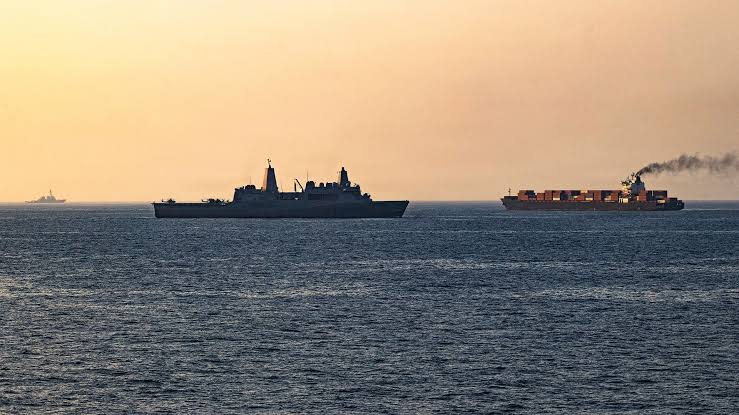
US heavy strikes Iran IRGC Qeshm Jordan Saudi Arabia 2026 entered its most geographically expansive and symbolically significant phase on Wednesday night when US Central Command completed what it described as a heavy wave of strikes against dozens of IRGC targets in retaliation for Tuesday's Iranian ballistic missile attacks on American forces in Jordan and the IRGC's striking of three oil tankers in the Strait of Hormuz, while Iranian state media reported three members of a family killed on Qeshm island including a two-year-old child, and the week simultaneously produced the first publicly announced joint US-Saudi strikes targeting Iranian proxies in Iraq, the first drone attack on an Egyptian port, and Jordan's air defence systems shooting down five Iranian missiles targeting the Kingdom's territory on Thursday. The conflict that President Trump said when it began in February would last only a few weeks has now stretched to five months with no end in sight, expanding its geographic scope, its civilian casualty profile, and its regional entanglement in ways that the week's events document with particular clarity.
"We're going to be hitting them very hard because it's our turn to hit them," Trump told reporters at the White House after Tuesday's IRGC Jordan base attack. "They know it's coming. They asked us not to do it."
The heavy wave of US strikes began at 20:00 ET on Wednesday and lasted approximately an hour, with Centcom describing them as a powerful response to Tuesday's attempted Iranian attacks on US forces. Centcom confirmed all Iranian missiles had been intercepted before impact. The targets included military command centres, missile and drone facilities, coastal surveillance and defence sites, and maritime capabilities across the Qeshm and Abadan island areas that Iranian state media agency Irib confirmed were struck, with both islands described as central to the oil industry and therefore carrying the specific economic warfare dimension that their targeting adds to the military strike rationale.
The civilian casualty documented on Qeshm is the most morally devastating specific incident of the week's strikes. Fars news agency, citing the Hormozgan University of Medical Sciences, reported that a US attack on a residential home in the Chah Tangu neighbourhood of Qeshm killed three members of a family: the father, the mother, and their two-year-old child. The specific detail of the child's age is the single most powerful accountability data point in the week's events, transforming an abstract strike operation count into the concrete human reality that the conflict's civilian cost requires being measured against regardless of the military justification that the IRGC's Jordan base attack provides for the retaliation.
The Full Sequence of a Week That Changed the Conflict's Shape
The week's events must be understood as a sequence whose individual incidents connect through the specific escalation logic that each IRGC action and each US response establishes, rather than as isolated episodes that can be assessed independently.
The relative calm and the diplomatic pause. For several days before Tuesday, both sides had halted strikes as talks apparently restarted in hopes of a diplomatic solution. Trump characterised them as very friendly negotiations while Tehran denied any discussions were happening, creating the specific diplomatic ambiguity that has characterised every ceasefire or near-ceasefire period in the conflict. The pause ended with the IRGC's Tuesday action.
Tuesday's IRGC Iran attack on Jordan. The IRGC said it targeted a US air base and a command centre in Jordan in response to the acts of aggression of the American child-killing army, the specific Iranian framing that situates their own attack as defensive retaliation and whose child-killing language is now contested by the Qeshm child death that the US heavy wave's subsequent civilian casualty creates. Jordan's armed forces confirmed that air defence systems shot down five Iranian missiles targeting the Kingdom's territory on Thursday, providing the defensive success narrative alongside the confirmation of the attack itself.
Tuesday's IRGC Hormuz tanker attacks. The IRGC's naval forces struck three oil tankers in the Strait of Hormuz after what Iran described as the vessels ignoring warnings and sailing along an unsafe and illegal route, asserting the Hormuz navigation authority claim that has been the most persistent structural dispute in the conflict's entire trajectory. The unsafe and illegal route characterisation is Iran's specific framing of the navigation channel dispute that the ceasefire framework has repeatedly failed to resolve, with each IRGC tanker attack functioning as both military retaliation and a coercive enforcement of the navigation authority claim that the US has rejected throughout.
Wednesday's heavy wave US retaliation. Centcom's heavy wave lasting approximately one hour and hitting dozens of IRGC targets including military command centres, missile and drone facilities, coastal surveillance sites, and maritime capabilities represents the escalated US response that Trump's we will hit them very hard framing promised and that the Qeshm family deaths document produced at the civilian cost that infrastructure-adjacent strikes consistently carry.
The joint US-Saudi Iraq strikes. The first publicly announced joint US-Saudi strikes, targeting multiple terrorist logistics and weapons sites across eastern Iraq in response to over 30 IRGC-directed aerial drone attacks in the last 72 hours, represent the most significant escalation in the conflict's geographic and coalition scope, bringing Saudi Arabia into direct military action against Iran-aligned forces for the first time in this conflict phase. Iraq's PMF said at least 20 of its members were killed. The Iraqi presidency denounced the strikes as an unacceptable attack and a blatant violation of Iraq's sovereignty. Trump told Fox News the strikes had been co-ordinated with the Iraqi government, creating the specific contradictory claims about Iraqi consent that bilateral military operations on third-country soil consistently generate.
Egypt's drone port attack. The Egyptian government's confirmation that a fire at a port on Wednesday was caused by a drone attack marks the first time Egypt has been directly attacked during the recent conflict, extending the geographic scope to a major US ally that has not previously been a target and whose involvement creates the specific regional expansion alarm that attacks on new countries' territory consistently generate.
The Five-Month Conflict's Structural Escalation Logic
The specific reason each week's events escalate beyond the previous week's is the absence of a resolution mechanism that is operationally binding on both sides' military forces and whose violation carries consequences that deter the violations that have driven each successive escalation cycle. The conflict that began on February 28 with joint US-Israeli strikes on Iran has now produced the specific series of ceasefire attempts, near-agreements, violated truces, and re-escalations whose pattern documents the structural failure to resolve the underlying disputes that make each military pause temporary rather than permanent.
Trump's February prediction that the war would last only a few weeks was the specific optimism whose refutation by five months of continued conflict is the most direct measure of the gap between the administration's initial assessment of the conflict's manageability and the operational reality that the IRGC's demonstrated capacity to sustain military pressure, the Hormuz navigation authority dispute's proven irresolvability through ceasefire text alone, and the Lebanon-Israel conflict's persistent provision of escalation triggers have collectively produced.
The Saudi Arabia entry into joint military action with the US represents the most consequential political development of the week, not primarily because of the immediate military impact of the PMF strikes in Iraq but because of what it signals about the regional alignment that the five-month conflict is consolidating. Saudi Arabia and Iran have been locked in a struggle for regional dominance for decades, with the specific Sunni-Shia sectarian dimension that the Saudi-Iran rivalry expresses being the deepest structural divide in the Middle East's religious and political geography. Saudi Arabia's decision to join US strikes on Iranian-aligned forces in Iraq, even while reportedly conveying to Trump through Prince Khalid bin Salman a desire to de-escalate tensions, documents the specific incoherence that the conflict is creating in Saudi strategic positioning between its de-escalation preference and its alignment with the US military campaign that makes de-escalation harder.
The Egyptian port drone attack's significance lies precisely in its novelty: Egypt has not been a direct military target in this conflict despite its status as a major US ally and its geographic position at the entrance to the Suez Canal, which is one of the world's most critical shipping corridors whose security is connected to the Red Sea and Hormuz dynamics that the conflict has been disrupting. An IRGC-connected drone attack on an Egyptian port, if attribution holds, represents the specific geographic expansion of the conflict into the Mediterranean-adjacent North African zone that would create the most direct threat to European energy security through channels beyond Hormuz itself.
The Conflict's Escalation Pattern Over Five Months
February 28: Joint US-Israeli strikes on Iran begin the conflict. Trump predicts weeks, not months.
March to May: Initial conflict phase with Hormuz closure, Gulf state proxy attacks, and the first ceasefire framework attempts through Pakistani mediation. Multiple near-agreements collapse over Hormuz navigation authority and nuclear programme disposition.
June: June memorandum of understanding is signed, briefly appearing to end the conflict. The memorandum defers the Hormuz navigation authority question to 60-day talks, leaving the structural re-escalation trigger intact.
Late June to early July: June ceasefire collapses over Hormuz navigation enforcement. Nine consecutive nights of US strikes on Iran through July 9. Oil reaches $90 a barrel. 17 American service members killed. Two oil tankers explode in Hormuz.
Mid-July: A second ceasefire agreement is signed in Switzerland following Pakistani mediation. Both sides halt strikes. Diplomatic talks described as restarting. Trump calls them very friendly negotiations while Tehran denies discussions are happening.
Late July, this week: IRGC ballistic missile attack on US base in Jordan and three Hormuz tanker strikes on Tuesday end the brief pause. Trump vows retaliation. Centcom completes heavy wave of strikes Wednesday night. Qeshm family of three including two-year-old child killed. First joint US-Saudi strikes on Iraqi PMF bases. Egypt port drone attack for the first time. Jordan shoots down five Iranian missiles. Saudi Arabia conveys de-escalation desire while participating in Iraq strikes.
Trump, Tehran, Baghdad, Riyadh, and Cairo All Managing Impossible Positions
The political management challenge of the current conflict phase is more complex than any previous phase because the number of governments whose positions are simultaneously in tension has expanded to include Iraq, Saudi Arabia, and Egypt alongside the primary US-Iran bilateral dynamic that the conflict's framing has centred on.
Trump's political position continues to be defined by the specific gap between his February weeks-not-months prediction and the five-month reality, compounded by the continuing American casualties whose count has reached 17 dead and more than 420 wounded and whose political cost the November congressional elections make particularly urgent. The friendly negotiations framing of the diplomatic pause, contradicted by Tehran's denial and ended by Tuesday's IRGC attack, represents the specific diplomatic credibility loss that each failed ceasefire imposes on both sides' ability to present subsequent agreements as genuine rather than tactical pauses.
Tehran's political management of the conflict simultaneously requires sustaining the IRGC's military pressure that preserves Iran's strategic leverage, managing the domestic anxiety that the Qeshm family deaths and the wider civilian casualty accumulation from five months of US strikes creates, and maintaining the specific diplomatic space for the comprehensive settlement whose terms would be more favorable than continued indefinite conflict but whose domestic political management requires the resistance narrative that ceasefire acceptance undermines.
Saudi Arabia's dilemma is the most acute of the week's political management challenges, documented in the specific simultaneous actions of joining US strikes on Iranian-aligned Iraqi militias while conveying through Prince Khalid bin Salman a desire to de-escalate. A country that wants de-escalation while participating in strikes that will intensify the conflict is not maintaining a coherent strategic position but managing the specific competing pressures of its US alliance obligations, its Gulf security interests, and its IRGC-aligned militia neighbour in Iraq whose strength the PMF strikes are designed to reduce.
Iraq's sovereignty position is the most direct casualty of the week's events, with the Iraqi presidency's denunciation of the PMF strikes as an unacceptable attack and a blatant violation of Iraq's sovereignty creating the specific bilateral crisis with Washington that Trump's co-ordinated with the Iraqi government claim partially contests but cannot fully resolve given the Iraqi presidency's own statement.
Oil Prices, Qeshm's Oil Infrastructure, and the Egypt Canal Concern
The specific targeting of Qeshm and Abadan islands, both described as central to the oil industry, creates the direct economic warfare dimension that distinguishes this week's strikes from purely military infrastructure targeting. Qeshm island hosts oil processing and storage facilities whose damage would reduce Iranian oil export capacity, while Abadan's oil industry facilities are among the most historically significant in Iran's petroleum infrastructure. Whether this week's strikes actually damaged oil processing capacity or targeted only military sites on islands that also host oil facilities is the specific factual question whose answer determines the economic impact's magnitude.
Oil prices have been responding to each escalation and de-escalation cycle throughout the conflict, with the specific trajectory in the days following the heavy wave and Saudi Arabia's Iraq strikes reflecting the market's reassessment of the Hormuz closure probability that each new escalation produces. The Egypt port drone attack's economic significance is partly immediate, the specific port facility whose fire disrupts its operations, and partly systemic, the market's reassessment of whether the conflict is expanding toward the Suez Canal corridor whose disruption would be economically more severe than Hormuz alone in terms of its impact on Mediterranean and European trade.
The Conflict's Expansion and What Five Months of War Has Changed
Five months of the US-Iran conflict has produced specific structural changes in the global order that pre-conflict analysis did not fully anticipate and whose accumulation represents the conflict's true strategic cost beyond the immediate military and economic measures.
The US-Saudi military coordination in Iraq represents the specific regional alliance consolidation that the conflict is producing, aligning the Gulf's Sunni Arab states more directly with American military action against Iranian-aligned forces in a way that pre-conflict diplomatic hedging had been avoiding. The Saudi de-escalation desire combined with Saudi military participation is the specific strategic incoherence that extended conflicts impose on states that want the outcome but not the means, and whose resolution in the direction of either genuine de-escalation or deeper military commitment will shape the regional order's architecture beyond this conflict's conclusion.
Egypt's first attack as a direct target extends the conflict's geographic scope into the North African Arab world in a way that carries specific implications for the Red Sea-Suez corridor whose security is the critical remaining global shipping alternative to Hormuz-disrupted routes. An Egypt that is itself a conflict target rather than a stable intermediary changes the specific risk calculus of shipping companies, insurance markets, and energy infrastructure operators whose planning depends on Mediterranean and Red Sea access remaining outside the conflict zone that Hormuz has occupied for five months.
What to Watch Next
Watch for the specific assessment of civilian casualty accountability in the Qeshm family deaths, including whether the US military conducts an investigation into the strike on the residential home and what explanation it provides for civilian presence in the target area.
Watch for Saudi Arabia's next military and diplomatic actions, which will determine whether the PMF Iraq strikes represent a one-time co-ordinated action or the beginning of sustained Saudi military participation in the conflict and whether the de-escalation message Prince Khalid bin Salman conveyed to Trump produces any change in American strike tempo.
Watch for Iraq's government response to the PMF strikes beyond the sovereignty denunciation, including whether Baghdad takes formal diplomatic or legal action against the US and Saudi Arabia through international mechanisms or whether the co-ordinated with the Iraqi government claim Trump made produces the specific Iraqi government confirmation or denial that would clarify what co-ordination actually occurred.
Watch for Egypt's attribution of the port drone attack and its diplomatic response, including whether Egypt publicly attributes the attack to Iran, demands IRGC accountability, or manages the incident quietly to avoid being drawn more directly into a conflict whose geographic expansion to Egyptian territory is the specific development whose handling will determine Egypt's conflict positioning.
Watch for oil market response to the Qeshm and Abadan oil infrastructure targeting and the Egypt port attack, whose specific impact on global energy supply calculations will determine whether the conflict's already substantial energy market disruption enters a new escalation phase.