
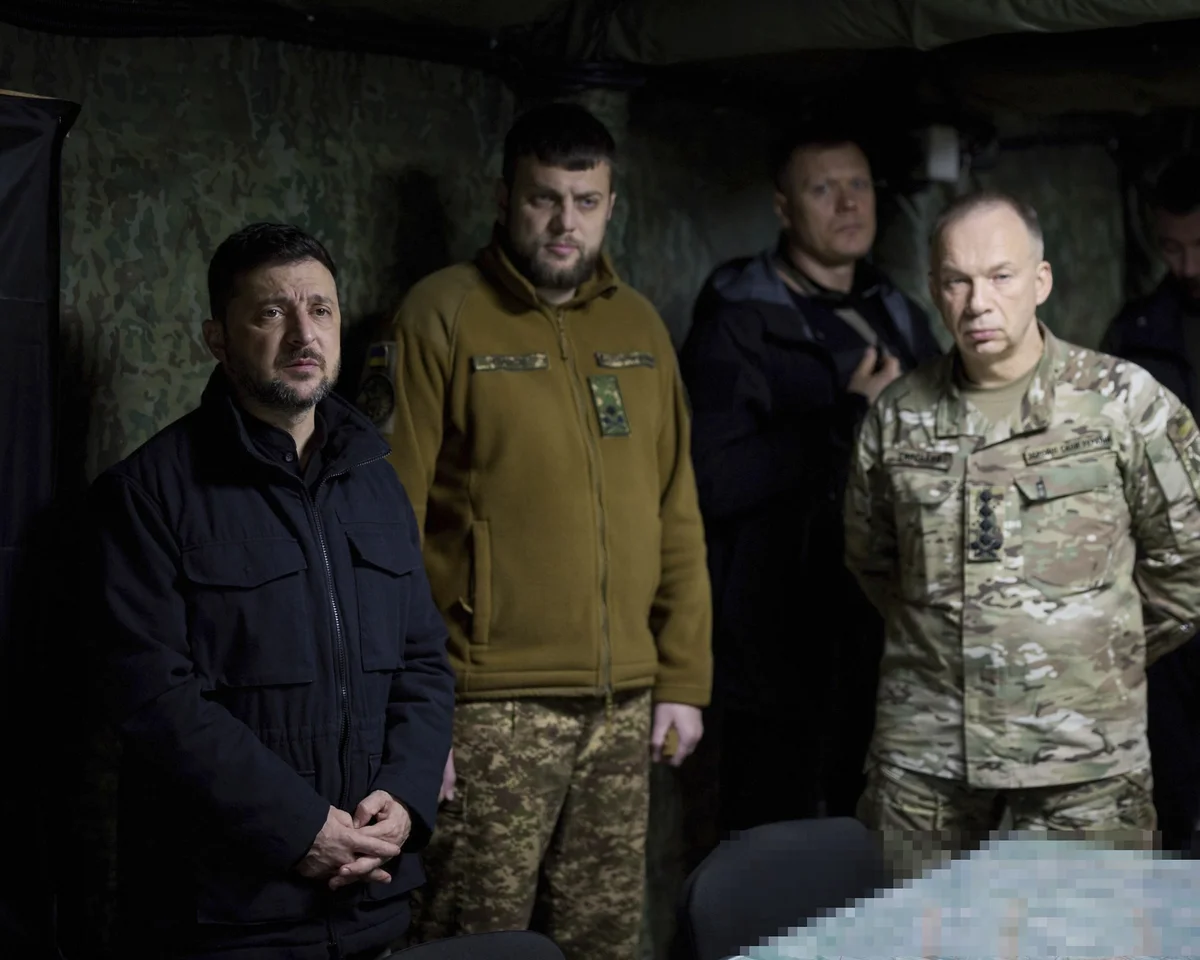
More than four years into Russia's full-scale invasion of Ukraine, a senior Ukraine war turning point battlefield commander is warning that the next six months will define not just the military outcome but the economic and diplomatic order that follows. Brigadier General Andriy Biletsky, who commands Ukraine's Third Army Corps and oversees more than one tenth of the entire front line, told Reuters that Russia's military is exhausted and no longer capable of the large-scale breakthroughs it achieved in earlier phases of the war.
For global markets, the significance of that assessment cannot be overstated. The war has been a persistent driver of energy price volatility, food supply disruptions, and defence spending surges across NATO economies since 2022. A genuine shift in battlefield momentum, one that forces Russia toward serious negotiations, could begin unwinding some of those pressures or, if the conflict intensifies first, deepen them further before any resolution takes hold.
Biletsky was unambiguous about the urgency of the moment. He said Ukraine needs to build and hold battlefield momentum for several months, take strategic positions along the front, and then enter peace negotiations from a position of strength rather than concession. "I believe the next six to nine months are a turning point," he said, speaking from an undisclosed underground location in the Kharkiv region. "More precisely, I think the next six are the most critical."
How the battlefield situation today compares to where the war stood a year ago
Russia's territorial advances, which were grinding and relentless through much of 2024 and early 2025, have slowed considerably in 2026. Ukrainian President Volodymyr Zelenskiy said last week that Ukraine had retaken nearly 600 square kilometres of territory this year alone, a figure Reuters could not independently verify but one that aligns with assessments from Western conflict analysts. Russia still controls close to one fifth of Ukrainian sovereign territory, making any talk of a decisive Ukrainian victory premature, but the direction of momentum appears to have shifted.
John Helin of the Black Bird conflict analysis group, based in Finland, told Reuters that Russian forces are showing clear signs of fatigue while Ukraine's biggest constraint remains a manpower shortage rather than a collapse in fighting capacity. His assessment mirrors Biletsky's: that Russia is more likely to reach its breaking point in the coming months than Ukraine is. The U.S.-based Institute for the Study of War added on Monday that Ukrainian forces are now actively challenging the static, positional character of the war and could soon be capable of limited mechanised assaults, a significant tactical evolution.
A year ago, the picture looked markedly different. Russian forces were advancing steadily through eastern Ukraine, Ukrainian frontline defences were under sustained pressure, and Western military aid was arriving too slowly to make a decisive difference. The shift in 2026 is partly technological: Ukraine has stepped up medium-range drone attacks on Russian air defences and logistics networks, enabling longer-range strikes to penetrate deeper into Russian territory and hit oil and military infrastructure. Elon Musk's decision to cut Russian forces off from Starlink satellite internet has also, according to Biletsky, left Moscow "radically losing" in battlefield communications.
The Donetsk deadlock is the key obstacle blocking any peace deal and market stabilisation
At the centre of stalled U.S.-backed peace negotiations is the question of who controls the Donetsk region. Russia demands the entire region, which it unilaterally declared annexed in 2022. Ukraine refuses to withdraw from the portions of Donetsk that Russian forces have been unable to capture militarily. That standoff has made meaningful ceasefire talks functionally impossible, and for commodity markets, it means the war's disruption of grain exports, energy flows, and supply chains remains unresolved.
Biletsky's strategy is designed precisely to change that calculus. If Ukraine can take and hold key positions along the Donetsk front over the next six months, it could make Russia's maximalist territorial demands militarily unachievable and economically costly enough to force a compromise. The Fortress Belt, a constellation of heavily fortified cities in eastern Ukraine, is the immediate battlefield focus. Fighting is raging inside Kostiantynivka, the belt's southern anchor, while Biletsky's forces are holding the northern bastion of Sloviansk and forcing Russia into costly frontal assaults that are degrading its field command structure.
For the global economy, a peace process that begins from Ukrainian battlefield gains would look very different from one negotiated under Russian military pressure. The former could support a gradual reopening of Black Sea grain corridors, a stabilisation of European energy markets, and a reduction in the defence spending that has crowded out social and infrastructure investment across much of the EU and NATO. The latter would likely entrench existing disruptions and accelerate the economic decoupling between Western economies and Russia that has been building since 2022.
Drone warfare, robots, and Starlink: the technology reshaping the war's economic stakes
One of the clearest signals that this war has entered a new phase is the speed at which both sides are deploying novel battlefield technology. Biletsky's Third Army Corps is leading Ukraine's effort to integrate unmanned ground vehicles, kamikaze drones, and robots armed with machine guns or rocket launchers directly into frontline operations. His target is to replace 30 percent of infantry soldiers with autonomous or semi-autonomous systems by 2027, a goal that reflects both the manpower constraints Ukraine faces and the direction military technology is heading globally.
Ukraine currently leads Russia in unmanned ground vehicles and heavy bomber drones, according to Biletsky, while Russia holds an advantage in fibre-optic drones, which cannot be electronically jammed. The technological parity between the two sides means neither can achieve a clean decisive advantage through hardware alone, reinforcing the importance of the six-month momentum window that Biletsky is describing. For defence contractors, technology investors, and governments evaluating military procurement, the lessons emerging from this conflict in real time are already reshaping spending priorities across Europe, Asia, and North America.
The Starlink factor is a particularly striking dimension of the war's global economic entanglement. A decision by a single private company's billionaire founder to restrict a satellite internet service has materially degraded the battlefield communications of a nuclear-armed state. That kind of private-sector leverage over state military operations is unprecedented in modern warfare, and its economic and regulatory implications are already being debated in capitals from Brussels to Tokyo as governments assess their own dependencies on commercial space infrastructure.
What a turning point in Ukraine means for energy prices, defence budgets, and global trade
If Biletsky's six-month assessment proves accurate and Ukraine successfully shifts the battlefield balance, the downstream effects on the global economy would be substantial. European energy markets have spent four years adapting to the loss of cheap Russian pipeline gas, with significant cost consequences for industry and consumers. A credible path to negotiated peace would not immediately reverse those structural changes, but it would reduce the risk premium embedded in energy prices and ease pressure on European central banks still managing inflation partly driven by war-related supply shocks.
Defence budgets across NATO have expanded significantly since 2022, with several European nations surpassing the alliance's 2 percent of GDP spending target for the first time. A durable ceasefire would not immediately reverse that trend, as European governments have stated long-term commitments to rebuilding military capacity regardless of the war's outcome. But it would redirect the urgency and pace of that spending, opening space for debate about how much is enough and where resources should flow once immediate threat levels decline.
For global trade, the most tangible near-term impact would be in agricultural commodity markets. Ukraine remains one of the world's largest exporters of wheat, corn, and sunflower oil. Any durable agreement that secured the Black Sea shipping lanes would push grain prices lower, with direct benefits for food-importing nations across Africa, the Middle East, and South Asia that have absorbed significant food inflation since 2022. The next six months in eastern Ukraine, in other words, are not just a military story. They are an economic one with consequences that reach far beyond the front line.