
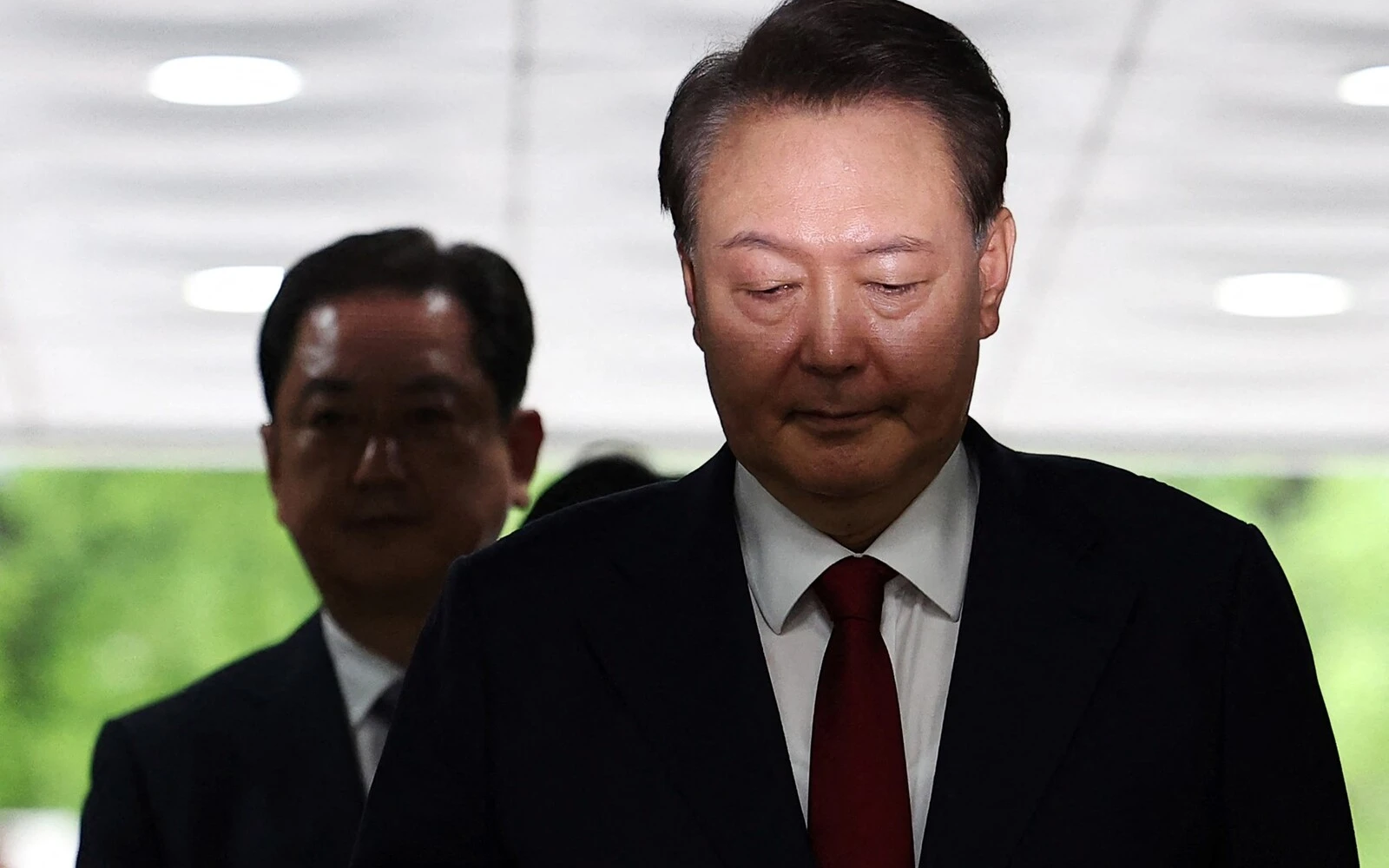
Yoon Suk Yeol appeals court jail term seven years 2026 has been handed down by the Seoul High Court, which increased the former South Korean president's prison sentence from the five years a lower court imposed in January to seven years after finding him guilty of additional charges including mobilising the presidential security service to prevent authorities from executing an arrest warrant against him. The ruling was delivered by a special court division established specifically to handle cases linked to the December 2024 martial law declaration, and it was televised in full, reflecting the extraordinary public and constitutional significance of judicial proceedings against a former head of state who declared martial law and was subsequently impeached, removed from office, and jailed. The Seoul High Court judge stated directly that in trying to stop authorities from executing an arrest warrant by use of force, Yoon committed acts that are unacceptable in a society of law and order, a formulation that frames the sentencing increase not as a marginal adjustment but as a response to conduct that violated the foundational principles of the constitutional democracy he had sworn to uphold.
The 65-year-old former prosecutor turned politician, who was impeached and removed from office last year and has been in jail since July, faces a cumulative legal situation of extraordinary severity that goes well beyond Wednesday's seven-year sentence. Among the eight trials Yoon faces since his removal, he was sentenced to life imprisonment in February for masterminding an insurrection tied to his imposing martial law in 2024, a sentence that represents the most serious legal consequence any South Korean former president has received in the country's democratic history. The obstruction charges for which Wednesday's seven-year sentence was handed down relate to the secondary conduct around the martial law attempt rather than the insurrection itself, covering the specific acts of fabricating official documents, failing to follow the legal process required for martial law, and using the presidential security service as a tool for resisting lawful arrest. Yoon has denied wrongdoing throughout all proceedings, and his lawyers announced immediately after Wednesday's ruling that they would appeal to the Supreme Court, calling the appeals court's decision incomprehensible and arguing that the court erred in applying rigid legal principles to what they characterised as political acts.
The prosecution had sought a 10-year prison term, accusing Yoon of betraying public trust, undermining the constitutional order, and using state resources to privatise public power, a trio of accusations that capture the three-dimensional nature of the legal case against him: the personal betrayal of the democratic mandate he held, the systemic damage to the constitutional framework that his actions caused, and the specific abuse of governmental resources for personal and factional purposes that the obstruction charges document. The appeals court's seven-year decision falls between the prosecution's 10-year request and the lower court's five-year original sentence, reflecting the court's finding that the lower court had under-weighed the seriousness of the additional charges while not fully accepting the prosecution's most severe characterisation of the conduct's overall culpability. Yoon's own appeal of the lower court's decision, in which he argued that the court ignored evidence and misinterpreted facts, was rejected by the appeals court's decision to increase rather than reduce the original sentence.
The Martial Law Declaration, Its Immediate Collapse, and the Legal Consequences
Yoon Suk Yeol's declaration of martial law in December 2024 was one of the most dramatic and most rapidly reversed political events in South Korean democratic history, a presidential action that invoked emergency powers that the country's constitution authorises in specific circumstances but that the National Assembly's swift and decisive response neutralised within hours of its announcement. Martial law in South Korea requires discussion at a formal cabinet meeting before it can be legally implemented, a procedural safeguard that Yoon bypassed in his declaration, providing one of the specific legal grounds for the charges he has faced across multiple trials. The National Assembly convened an emergency session overnight and voted to nullify the martial law declaration, invoking the legislative check on executive power that the constitutional framework had been designed to provide precisely for situations where executive action exceeded its legitimate bounds.
The speed with which the National Assembly invalidated the martial law declaration reflected both the strength of the constitutional checks that constrain presidential emergency powers in South Korea and the breadth of the political opposition to Yoon's action that had developed during his presidency. Yoon had been engaged in an increasingly bitter conflict with the opposition-controlled National Assembly over his government's policy agenda, budget priorities, and personnel decisions, and his declaration of martial law was characterised by his government as a response to what it described as legislative obstruction of executive governance. Opposition parties and most constitutional scholars rejected that characterisation, arguing that legislative checks on executive power are precisely the mechanism that the constitutional framework is designed to preserve, and that using martial law to bypass those checks represents the kind of fundamental constitutional violation that the impeachment and legal processes have subsequently confirmed.
The failure of the martial law declaration within hours did not end the constitutional crisis but transformed it from an acute emergency into a sustained legal and political reckoning whose dimensions have continued to expand across the months since December 2024. Yoon's impeachment by the National Assembly, the Constitutional Court's confirmation of the impeachment and removal from office, the multiple criminal trials covering insurrection, obstruction, document fabrication, and related charges, and the accumulating sentences including the February 2026 life imprisonment for insurrection and Wednesday's seven-year sentence for obstruction represent the systematic legal processing of what the courts have found to be a comprehensive assault on South Korea's constitutional order by the president who was constitutionally obligated to protect it.
The Presidential Security Service Mobilisation and Why It Added New Charges
The specific finding that resulted in the appeals court increasing Yoon's sentence from five to seven years, his mobilisation of the presidential security service to prevent authorities from executing an arrest warrant, represents a distinct category of constitutional violation that the lower court had treated differently from the direct martial law charges but that the appeals court found more seriously warranted additional punishment. The presidential security service is an elite protection detail whose institutional mandate is to protect the president and other designated officials from physical threats, a function that is entirely legitimate and necessary within a constitutional democracy. Using that service to obstruct the execution of lawful judicial process is a fundamental perversion of its institutional mandate, converting a constitutional protection mechanism into a tool for the president's personal resistance to legal accountability.
The arrest warrant obstruction incident occurred during the period between the martial law declaration's failure and Yoon's eventual detention, when authorities attempting to execute judicial process against him encountered resistance from elements of the presidential security service that Yoon had directed to prevent his arrest. This specific incident became the subject of intense public and media attention at the time because it placed the presidential security service in direct confrontation with law enforcement and judicial authorities executing a lawful warrant, creating a visible and documented instance of the use of state resources to obstruct justice that the appeals court found unacceptable in a society of law and order. The judge's specific language in articulating why this conduct warranted additional punishment reflects the court's assessment that using force to resist a lawful arrest is qualitatively different from other constitutional violations in its direct challenge to the rule of law's most basic operational requirements.
The charges related to fabricating official documents and failing to follow the legal process required for martial law, also finding Yoon guilty beyond what the lower court had determined, add to the documentary and procedural evidence of a martial law process that was conducted in deliberate disregard of the constitutional requirements designed to prevent exactly the kind of unilateral executive action that Yoon's declaration represented. Official document fabrication in the context of martial law administration raises specific concerns about the integrity of the governmental record-keeping that should document and constrain the exercise of emergency powers, and finding Yoon guilty of this charge establishes that the constitutional violations extended beyond the declaration itself to the attempted legitimisation of that declaration through fraudulent documentation.
South Korea's Democratic Tradition and the Precedent of Presidential Accountability
South Korea's treatment of its former presidents through criminal accountability processes is itself a distinctive feature of the country's democratic development, reflecting both the genuine commitment of the Korean legal and political system to applying legal standards equally regardless of political status and the specific history of executive power abuse that has made accountability for presidential misconduct a politically salient issue across multiple generations of South Korean governance. Former Presidents Chun Doo-hwan and Roh Tae-woo were convicted of mutiny and corruption charges in the 1990s for their roles in the 1980 military coup and subsequent governance abuses, establishing the precedent that South Korean courts would hold former presidents criminally accountable for serious constitutional violations regardless of their political significance.
The subsequent accountability proceedings against other former presidents including Lee Myung-bak and Park Geun-hye, both of whom were convicted of corruption charges in proceedings that followed their departures from office, extended the accountability tradition into the more recent democratic period and established that the pattern was not specific to the military-era presidents but reflected a consistent institutional commitment to legal accountability that applies regardless of the political circumstances of the specific case. Yoon's cases, covering charges of a different and more fundamental constitutional character than the corruption cases of his predecessors, represent the most severe application yet of this accountability tradition, both in the seriousness of the charges and in the scale of the sentences that courts have imposed.
The Constitutional Court's confirmation of Yoon's impeachment, combined with the multiple criminal trials and accumulating sentences, demonstrates the functional independence of South Korea's judicial and constitutional institutions in processing a case that has profound political implications for the current government and for the country's democratic self-understanding. The televised nature of Wednesday's appeals court ruling reflects a judicial system confident enough in its own legitimacy and in public support for the accountability process to conduct its most sensitive proceedings in public view, treating transparency as reinforcing rather than threatening the credibility of the judicial process in a case where the defendant and his supporters have consistently argued that political bias has influenced the legal outcomes.
Seven Years on Appeal, Supreme Court Challenge Ahead, and Eight Total Trials
The seven-year sentence handed down by the Seoul High Court on Wednesday covers the obstruction and procedural violation charges that are legally distinct from the insurrection conviction that produced Yoon's February 2026 life sentence, and the relationship between these multiple proceedings reflects the multi-dimensional legal framework within which the courts are processing the martial law episode's consequences. The insurrection conviction, which carries the most severe possible sentence in the South Korean legal system, addresses the fundamental constitutional character of the martial law declaration as an attempt to overthrow or undermine the constitutional order. The obstruction and procedural charges covered by Wednesday's sentence address the specific subsequent conduct of resisting arrest, fabricating documents, and bypassing required procedures, treating those acts as independently cognisable criminal conduct rather than merely as elements of the broader insurrection.
The eight total trials that Yoon faces across the range of charges that have been filed since his removal from office create a legal complexity that is unusual even by the standards of major political accountability cases, reflecting both the breadth of the prosecutorial theory about his conduct and the procedural requirements of the South Korean criminal justice system that require charges to be grouped and tried in specific ways. Each trial produces its own factual record, its own set of convictions or acquittals, and its own sentence that must eventually be reconciled with the sentences from other proceedings into a comprehensive legal disposition. The accumulation of multiple severe sentences, including a life sentence for insurrection and a seven-year sentence for obstruction, means that Yoon's total legal exposure is effectively a life sentence regardless of how the Supreme Court appeal of Wednesday's decision resolves, since the insurrection conviction alone would accomplish that result if sustained.
The special court division established to handle the martial law cases, of which Wednesday's ruling was the first decision, represents an institutional innovation in the South Korean judicial system designed to manage the unprecedented volume and complexity of proceedings connected to a single constitutional episode. The division's first decision to increase rather than maintain or reduce the lower court's sentence sends a specific institutional signal about how it interprets the seriousness of the martial law episode's legal dimensions, and its televised delivery ensures that the signal reaches both the public audience and the appellate courts that will ultimately determine the definitive legal resolution of Yoon's cases.
The Supreme Court Appeal and What It Could Change
Yoon's lawyers' immediate announcement that they would appeal Wednesday's decision to the Supreme Court continues the legal strategy of contesting every adverse decision through the full range of available judicial processes, a strategy that is both a legitimate exercise of legal rights and a time-extension mechanism that keeps open the possibility of legal reversals even as the weight of convictions continues to accumulate. The characterisation of the appeals court's ruling as incomprehensible and the argument that the court erred in applying rigid legal principles to political acts represents the most philosophically interesting element of the defence strategy, raising questions about the boundary between legal and political characterisation of conduct that go to the heart of how constitutional violations should be processed in a democratic legal system.
The argument that political acts should be evaluated under different legal principles than ordinary conduct is not without academic support in the political science and legal theory literature, where concepts of political necessity and constitutional moments have been used to argue that extraordinary political crises require extraordinary political responses that conventional criminal law frameworks are inadequate to evaluate. The courts that have heard Yoon's cases have consistently rejected this argument, finding that the constitutional framework itself provides the standards by which emergency measures must be assessed and that compliance with those constitutional standards is not an optional constraint on executive action during crises but a mandatory one whose violation constitutes crime rather than political judgment. The Supreme Court will provide the definitive resolution of this legal question when it eventually rules on Yoon's appeal.
The political implications of the accumulating legal proceedings for South Korean governance and for the current administration that replaced Yoon's government extend beyond the specific cases to the broader question of how democratic societies process extreme executive conduct while maintaining institutional continuity and public confidence in the constitutional framework. South Korea's consistent and transparent application of legal accountability processes to its former president, including the televised appeals court ruling and the special court division's first decision, represents a model of democratic institutional resilience that processes constitutional violations through established legal frameworks rather than either avoiding accountability for the sake of political stability or conducting proceedings that compromise the independence and credibility of the judicial institutions involved. Wednesday's seven-year sentence is one more step in that ongoing institutional reckoning.