
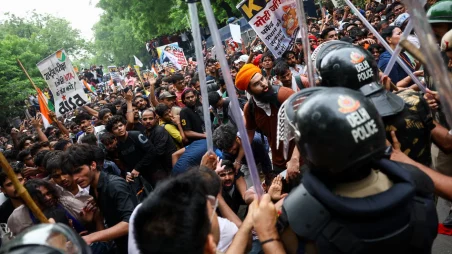
On Monday, thousands of young protesters from Delhi and surrounding cities marched on India's parliament in New Delhi, responding to a call from the Cockroach Janta Party, a youth-led movement demanding the resignation of Education Minister Dharmendra Pradhan over examination paper leaks. Delhi Police, which had denied the march permission, deployed hundreds of officers and paramilitary personnel to block the route. Clashes erupted. By the time they ended, Delhi Police reported 180 people injured, including 118 security and police personnel and 60 protesters. Seventy demonstrators were detained and face legal action.
On Tuesday morning, CJP founder Abhijeet Dipke stood at a press conference and announced the movement would continue its protest but would not march again. His reasoning was direct.
"We will not march again because the police will hurt the youth again. We had to call off the protest yesterday because we did not want more youth to be injured."
Abhijeet Dipke, founder, Cockroach Janta Party, press conference July 22, 2026
Around 150 to 200 protesters had gathered at Jantar Mantar in central Delhi early on Tuesday, chanting slogans in light rain, as paramilitary personnel continued to patrol the area and barricades slowed surrounding traffic. The movement has not disbanded. It has changed tactics.
Why it happened The NEET scandal that lit the fuse
To understand why millions of young Indians have rallied behind a movement that calls itself the Cockroach Janta Party, you have to understand what happened in May to more than two million students sitting India's most competitive entrance examination.
The National Eligibility cum Entrance Test, known as NEET, is the gateway to medical education in India. Every year, millions of students spend years preparing for a single examination that determines whether they will enter a medical college. In May 2026, allegations emerged that the NEET paper had been leaked before the examination took place, giving some candidates advance access to questions. The examination was cancelled. For the more than two million students who had sat it, that cancellation meant their preparation, in some cases years of it, had been rendered worthless by a failure of the system rather than by their own performance.
The CJP and affected families have alleged that at least 20 students died by suicide following the cancellation. Those individual deaths gave the movement moral weight that no amount of social media satire alone could have generated. When families began speaking publicly about what they had lost, and when those accounts were amplified through networks of young people who understood exactly what NEET failure means for a student's life prospects in India, the CJP's online campaign found an offline constituency that was ready to march.
For two million students, NEET was not an exam. It was years of their life. Its cancellation over a paper leak felt like a theft committed by the state and unpunished by it.
From a judge's insult to a march on parliament
Late 2025
India's Chief Justice compares sections of unemployed young people to "cockroaches" during a court hearing. The remark is criticised and later withdrawn.
Late 2025
Activist Abhijeet Dipke founds the Cockroach Janta Party as a satirical student-led collective, adopting the insult as a symbol of resilience. The movement grows rapidly on social media among Gen Z Indians.
May 2026
NEET, India's national medical entrance exam, is cancelled over allegations of paper leaks. More than two million students are directly affected. CJP and families allege at least 20 students subsequently die by suicide.
July 2026
Activist and educator Sonam Wangchuk begins a hunger strike in support of CJP demands. CJP calls for a march on parliament. Wangchuk is forcibly hospitalised by police on day 21 of his fast.
Monday July 21
Thousands march on parliament. Delhi Police, which had denied permission, deploys paramilitary forces. Clashes result in 180 injuries. Seventy protesters detained. CJP founder Dipke calls off the march to prevent further injuries.
Tuesday July 22
Dipke announces the CJP will continue protesting but will not march again. Approximately 150 to 200 demonstrators continue their vigil at Jantar Mantar under tight security. Three AISA hunger strikers end their 23-day fast.
Modi's biggest street-level challenge in his third term
India has seen significant protest movements in recent years, from anti-corruption campaigns to the farmers' protests that forced the Modi government to reverse three agricultural laws in 2021. But those movements drew primarily from older demographics and specific economic communities. The CJP represents something the current government has not faced before in this form: a politically unattached, digitally organised, socioeconomically diverse generation of young people whose grievance is the examination system itself, and whose demands are targeted at a specific minister.
The demand for the resignation of Education Minister Dharmendra Pradhan puts the government in a difficult position. Accepting the demand would be interpreted as an admission of institutional failure and could embolden other protest movements. Refusing it while the injured students' stories circulate on social media platforms used daily by the movement's core constituency creates sustained political cost. Mass protests converging on the national capital's power centre have become relatively uncommon in recent years, partly because tighter policing and restrictions on public gatherings have made large-scale mobilisation near parliament logistically difficult. The fact that the CJP achieved it, even briefly, before being pushed back demonstrates a level of organisational capacity that the government will now have to take seriously.
The involvement of Bollywood stars in appeals to end the hunger strikes of AISA protesters is a cultural indicator of how broadly the movement's message has resonated. When celebrity culture, student activism, and parental grief converge on the same demand, the political terrain becomes genuinely difficult for any government to navigate through policing alone. The 118 police officers injured in Monday's clashes will be used by the government to justify the deployment. The 60 protesting students injured in the same clashes will be used by the CJP to argue that the government's response was disproportionate. Both sets of figures will shape the next phase of the political contest.
what examination dysfunction costs India's human capital
The NEET controversy sits within a broader structural problem in India's economy that the CJP's protests have brought into sharp focus. India has one of the world's largest youth populations, with more than 600 million people under the age of 25. The country's economic growth projections depend significantly on converting that demographic dividend into productive human capital. That conversion requires an education and examination system that functions reliably, fairly, and at scale.
When a national examination that more than two million students have spent years preparing for is cancelled over a paper leak, the economic cost is not only the disruption to those individual students' career timelines. It is also a signal to the broader talent pipeline about the reliability of the institutions that are supposed to allocate opportunity on merit. A system perceived as corruptible by those with connections or resources enough to access leaked papers does not simply fail the students who are disadvantaged by the leak. It undermines the credibility of every credential the system produces, with implications for how employers, both domestic and international, assess qualifications from Indian institutions.
The suicide deaths alleged by the CJP and affected families, if borne out by independent investigation, represent a human capital cost of the most irreversible kind. India has consistently struggled with the mental health burden placed on young people by a hyper-competitive examination culture in which a single test can determine the trajectory of an entire life. The NEET cancellation, by removing even the certainty of a result, added a layer of uncertainty onto an already psychologically demanding system. Understanding that context is essential to understanding why the grief and rage of affected families has proved so politically combustible.
Brands, social media platforms, and the attention economy of Indian youth
The CJP movement's origins on social media and its sustained use of digital organising tools make it commercially significant for the platforms and brands whose revenues depend on Gen Z attention in India. A movement of this scale, built primarily through short-form video, meme culture, and rapid information sharing across platforms including Instagram, YouTube, and X, demonstrates the mobilisation capacity of Indian Gen Z in ways that marketers and platform economists track carefully. Brand associations with youth culture in India now operate in an environment where that culture can pivot from entertainment to political protest with remarkable speed.
The education sector itself faces direct commercial scrutiny from the NEET controversy. India's private coaching industry, worth billions of dollars annually, is built on the premise that systematic preparation for NEET and other competitive examinations provides a reliable route to outcomes. When the examination itself is compromised, the value proposition of the coaching sector is questioned alongside the credibility of the government body that administers the test. Investors in edtech companies that have built business models around NEET preparation will be assessing the reputational and regulatory risk that a sustained political focus on examination reform creates for the sector.
what India's exam protest tells the world about Gen Z political mobilisation
The CJP's journey from a social media satirical campaign to a mass street movement that brought thousands to parliament and produced 180 casualties in a single day follows a pattern that has been observed in different forms across multiple countries in recent years. From the climate strikes to the anti-corruption movements in Latin America, from the student protests in Bangladesh in 2024 that contributed to a government change to the South Korean political uprisings of the same period, Gen Z political mobilisation has consistently demonstrated an ability to scale rapidly, organise without traditional party structures, and sustain momentum through digital networks that older protest movements did not have access to.
India's version of this phenomenon is distinctive in its scale, given the size of the country's youth population, and in its specific grievance, the NEET paper leak, which gives it a concrete and verifiable injustice at its core rather than a more diffuse political demand. International observers of Indian democracy, including human rights organisations, academic researchers, and foreign governments tracking India's domestic stability, will be watching how the Modi government responds to the CJP's sustained presence at Jantar Mantar and whether the movement's tactical retreat from marching translates into a sustained digital and community-level campaign that maintains political pressure without the legal exposure of unauthorised street marches.
Expert analysis
The CJP represents something genuinely new in Indian protest politics: a movement without a party patron, without a senior leader drawn from established civil society, and without a geographic base in a single state or community. Previous mass movements that converged on Delhi, including the Anna Hazare anti-corruption campaign of 2011 and the farmers' protests of 2020 to 2021, had identifiable leadership structures and community support bases that the government could negotiate with, co-opt, or wait out. The CJP's founder Abhijeet Dipke is a relatively unknown activist whose name recognition comes entirely from the movement he created. There is no established institutional counterpart for the government to engage with through back channels.
That structural characteristic makes the movement both harder to suppress and harder to resolve. It cannot be neutralised by arresting a figurehead whose removal would leave a power vacuum. But it also lacks the institutional staying power that organisations with staff, funding, and physical infrastructure can sustain over a long period. The CJP's decision not to march again is a tactically sensible response to Monday's violence, but it raises a question that all social-media-born movements eventually face: how do you maintain momentum and convert digital solidarity into sustained political pressure when the street-level action that generates media attention is no longer available?
What happens next
The CJP has said it will continue protesting but has not specified what form that protest will take following Monday's violence. The most likely near-term scenario is a shift toward sustained digital campaigning, legal challenges to the detention of 70 protesters, and coordinated pressure on the government through sympathetic political figures and civil society organisations. The AISA's continued stated support for CJP demands means the student association's organisational infrastructure remains available to the movement even after the end of the hunger strikes that drew national attention.
The government's response will determine much of what happens next. If Education Minister Dharmendra Pradhan resigns or if the government announces a credible independent inquiry into the NEET paper leak with binding reform commitments, the CJP would face pressure from its own supporters to declare at least a partial victory and assess what further action is warranted. If the government holds firm, pursues legal action against the 70 detained protesters, and treats Monday's clashes as a law-and-order matter rather than a political one, the movement is likely to seek international attention, escalate digital campaigning, and attempt to coordinate with sympathetic political parties ahead of any state elections that provide an electoral pressure point.
The 150 to 200 protesters who returned to Jantar Mantar in the rain on Tuesday morning, chanting slogans under tight security, signal that the movement's core is not dispersing. The question is whether that core can sustain the broader coalition of millions of young Indians whose support was expressed through digital solidarity more than street presence, and whether the next provocation, a court ruling on the detentions, a government statement on reform, or another visible incident, reignites the street-level mobilisation that Monday's violence temporarily halted.