
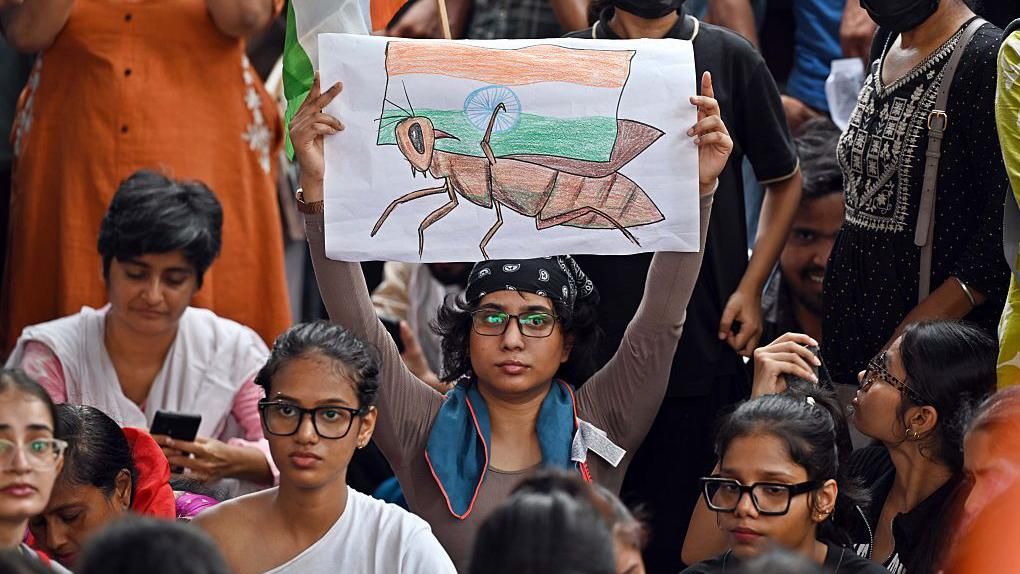
Thousands of protesters have returned to the streets of Delhi despite overnight monsoon rains, maintaining a round-the-clock sit-in at Jantar Mantar near India's parliament as the Cockroach Janta Party Protests movement enters a new and politically significant phase. What began as a satirical youth-led campaign demanding education reforms has evolved into one of the most visible and sustained expressions of public dissent against Prime Minister Narendra Modi's government in recent years, drawing in India's main opposition parties and placing direct pressure on the government at the precise moment the parliament's monsoon session began.
The movement centres on three core demands: the resignation of Education Minister Dharmendra Pradhan, accountability for police violence against protesters, and substantive reform of India's education system, including the scrapping of what protesters describe as a deeply flawed examination and recruitment framework that has left millions of qualified young Indians unable to access jobs their qualifications should entitle them to. The scale of the mobilisation, tens of thousands in Delhi on Monday alone, with parallel protests in Mumbai, Hyderabad, Bengaluru, and Ahmedabad, signals that the CJP has crossed the threshold from student activism into national political movement.
The government's response has oscillated between force and dialogue in ways that have satisfied neither protesters nor opposition politicians. Police used batons and tear gas on Monday's march, injuring at least 60 people and detaining Congress MP Rahul Gandhi and other senior opposition figures, who were later released. Education Minister Pradhan, speaking publicly for the first time since the violence, accused the Congress party of exploiting students as political tools while insisting the government remained committed to education reform. The CJP has not responded to Pradhan's comments. Pradhan's resignation, not his promises, is what the movement is demanding.
From Jantar Mantar to the Prime Minister's Door
Monday's march to parliament, timed to coincide with the start of the monsoon session, was the CJP's most ambitious mobilisation to date. Tens of thousands answered the call to march from Jantar Mantar, the 300-year-old astronomical observatory that has become India's most symbolic protest venue, toward parliament. Police blocked the march, deployed tear gas and batons, and dismantled the protest's stage and makeshift tents. At least 60 people were injured, including demonstrators and police officers. Video footage circulated widely on social media showing protesters being pushed, struck with batons, and loaded onto buses.
The following day, the opposition escalated its involvement. Congress president Mallikarjun Kharge and Rahul Gandhi led a surprise march to Modi's official residence, demanding the resignations of not just Pradhan but also Home Minister Amit Shah, who oversees the Delhi police that carried out Monday's crackdown, and Prime Minister Modi himself. Former Delhi Chief Minister Arvind Kejriwal and veteran politician Sharad Pawar also visited the protest site at Jantar Mantar, lending the movement the legitimacy of established political figures while reinforcing the government's difficulty in dismissing it as fringe activism.
Gandhi said he had sought a parliamentary debate on the issue by approaching Speaker Om Birla, but was told that government permission was required. "It was very clear to us that there was no interest in the government of having a debate," Gandhi told reporters. Federal Minister Jitendra Singh disputed this account, claiming the government had accepted Gandhi's request for a discussion but that Gandhi had then also demanded Pradhan's resignation, which Singh characterised as "changing the goalpost." The competing claims reflect the fundamental breakdown in communication between the government and the movement's political allies, with each side accusing the other of bad faith.
The Deep Roots of India's Education and Employment Crisis
The CJP protest movement did not emerge from nowhere. It is the visible expression of a structural crisis in India's education and employment system that has been building for years and has reached a breaking point among a generation of young Indians who invested years in preparation for competitive examinations only to find the system riddled with irregularities, alleged paper leaks, and opaque recruitment processes that appear to reward connections over merit.
India's competitive examination ecosystem is one of the world's most demanding. Millions of young people spend years, sometimes the entirety of their twenties, preparing for a small number of highly coveted government positions in teaching, civil service, railways, and other public sector roles. The examinations are administered at national and state level by bodies whose conduct has come under sustained scrutiny. Allegations of paper leaks, examination irregularities, and manipulation of results have surfaced repeatedly in recent years, with several high-profile cases reaching the courts and generating substantial public anger. For young people who sacrificed years of their lives and their families' savings on the preparation process, evidence of systemic irregularity is not an abstract governance concern but a personal catastrophe.
The satirical name Cockroach Janta Party derives directly from a remark made earlier in 2025 by India's Chief Justice, who used the word "cockroach" to describe unemployed young people who turn to journalism and activism rather than conventional employment. The Chief Justice subsequently clarified that he had been referring only to those with "fake and bogus degrees," but the damage was done. The remark catalysed a generation of young educated Indians who felt simultaneously dismissed by an authority figure and energised by the absurdity of the insult. Reclaiming "cockroach" as an identity, as a satirical political party rather than an insult, was an act of collective defiance that resonated far beyond the individuals directly targeted by the original remark.
How the CJP Movement Reached This Point
Earlier in 2025 — India's Chief Justice uses the word "cockroach" to describe unemployed young people turning to journalism and activism. The remark sparks immediate and widespread outrage among India's educated youth.
Following weeks — The Cockroach Janta Party emerges as a satirical movement reclaiming the insult. Despite not being a registered political party, it begins organising protests focused on education reform and examination integrity.
June 28 — Sonam Wangchuk, the prominent Ladakhi activist and educationist who inspired the character in the Bollywood film Three Idiots, joins the protesters at Jantar Mantar and begins an indefinite hunger strike in support of their demands. His involvement brings national and international attention to the movement.
One month of continuous protest — Demonstrators maintain a round-the-clock sit-in at Jantar Mantar for a full month, enduring heat, rain, and periodic confrontations with authorities.
Saturday before Monday's march — Police forcibly remove Wangchuk from the protest site and take him to hospital, where he continues his fast. The forced removal generates significant public sympathy.
Monday, monsoon session opening day — Tens of thousands march toward parliament. Police use tear gas and batons. At least 60 people injured. Congress leaders including Rahul Gandhi detained and released.
Tuesday — Demonstrations continue despite overnight rain. Congress leaders march to Modi's residence. Opposition leaders visit Jantar Mantar. Education Minister Pradhan makes his first public comments since the violence.
What the CJP Movement Means for Modi's Government and Indian Democracy
The CJP movement's political significance extends well beyond the specific demands around education reform. It represents the emergence of an organised, youth-led opposition force that operates outside the traditional party system while drawing in established opposition parties as allies rather than leaders. That dynamic, in which the CJP sets the agenda and the Congress party, the AAP, and other opposition formations respond to it, is politically unusual in India and potentially significant for the opposition's future electoral strategy.
For the Modi government, the protests pose a challenge on multiple levels simultaneously. The substantive demands, relating to examination integrity and education quality, touch on genuine governance failures that the government cannot simply dismiss without acknowledging the underlying problems. The political demands, for the resignations of Pradhan and Amit Shah, are non-negotiable for a government that regards conceding resignations under protest pressure as a dangerous precedent. And the optics of tear gas and batons being used against students holding signs about education reform are difficult to manage in an era of instant video sharing and social media amplification.
The Congress party's involvement, culminating in the march to Modi's house, represents an attempt to channel the energy of the CJP movement into established political opposition. Gandhi's characterisation of the parliamentary route as blocked, and his framing of the march to Modi's house as a response to that blockage, is a political argument designed to connect the CJP's specific demands to a broader narrative about democratic accountability under the Modi government. Whether that connection persuades undecided voters will depend on how the government responds in the coming days and whether the CJP movement maintains its momentum or begins to fragment under the pressure of sustained police opposition and competing political agendas.
The Cost of India's Broken Education-to-Employment Pipeline
The CJP movement's demands are rooted in an economic reality that has profound implications for India's development trajectory. India's demographic dividend, the advantage that comes from having a large working-age population, can only be realised if that population is productively employed. The alternative, a large cohort of educated young Indians unable to access employment commensurate with their qualifications, is not just a social problem but an economic one with consequences that compound over time.
India's youth unemployment rate is a contested figure, with different methodological approaches producing substantially different numbers. What is not contested is that the mismatch between the qualifications of India's educated young people and the jobs available to them, particularly in the government and formal private sectors, is a structural feature of the economy that periodic examination reform alone cannot address. The CJP protesters are not arguing against competitive examinations per se; they are arguing that the examination system as currently administered is not fit for purpose, that irregularities undermine meritocracy, and that the ministry responsible has not done enough to fix the problems.
For India's broader economy, the loss of trust in the examination and recruitment system has real costs. When talented young people believe that merit is not the primary determinant of examination success, the rational response is to invest in gaming the system rather than improving genuine competence. That dynamic, if pervasive, degrades the quality of the human capital flowing into public institutions and erodes the institutional quality that determines India's long-run economic performance. Foreign investors considering India's potential as a high-skill manufacturing and services hub have reason to watch how the government manages the education quality question, because the credibility of India's educational credentials is directly relevant to the proposition that India can produce the workforce quality that ambitious economic targets require.
What the Protests Signal for India's Education Sector and Tech Economy
India's private education sector, which has grown enormously as students seek coaching and preparation support for competitive examinations, faces its own set of implications from the CJP movement. The protest has drawn attention to the scale of the examination preparation economy and the enormous financial and personal investment that students make in a system they increasingly believe is rigged against merit. That perception, if it hardens, could accelerate demand for international education pathways and reduce the aspirational investment in domestic public sector examination preparation that currently sustains a large coaching industry.
For India's technology sector, which depends on a pipeline of engineering graduates and competes globally for talent, the education integrity debate has direct relevance. Companies that recruit from India's engineering institutions rely on academic credentials as a signal of candidate quality. Systemic examination irregularities at the government certification level raise questions about the reliability of those signals and create additional recruitment costs as companies develop their own assessment processes to compensate for reduced trust in official credentials.
The international education recruitment sector is watching India's education protest carefully. Countries including Canada, Australia, the United Kingdom, and Germany that have built significant international student recruitment businesses targeting Indian middle-class families will see the CJP protest as a signal of domestic frustration with the Indian education system, a frustration that often translates into parental decisions to send children abroad. Whether the government's response to the protests reassures or further alienates the middle-class families whose education choices have significant economic implications for both India and the destination countries will be one of the movement's more consequential indirect effects.
Why the World Is Watching India's Student Movement
The CJP movement has attracted international attention for several reasons that go beyond the specific Indian political context. India is the world's most populous country, the world's largest democracy, and an economy that the international community has been watching with growing interest as a potential counterweight to Chinese manufacturing dominance and a major emerging market for global investment and trade. When tens of thousands of educated young Indians take to the streets in the capital to demand accountability from their government for failures in the education system, it raises questions about the quality of Indian institutions that international investors, governments, and development organisations cannot ignore.
The involvement of Sonam Wangchuk, an internationally recognised figure whose work on education and environmental issues in Ladakh brought him global attention and whose story partly inspired the globally popular Bollywood film Three Idiots, has given the movement a human face recognisable beyond India's borders. His indefinite hunger strike, his forcible removal by police to hospital, and his continuation of the fast in hospital have generated international media coverage that amplifies the domestic political pressure on the government.
For the global governance conversation about the relationship between youth unemployment, education quality, and political stability, India's CJP movement is a case study in how structural economic failures can translate into organised political action. The pattern, educated young people unable to access opportunities commensurate with their qualifications turning to organised protest when they believe the system that was supposed to serve them is corrupt or dysfunctional, is not unique to India. It has played out in various forms in Tunisia, Egypt, China, and elsewhere. The specific form it takes in India, satirical, digitally organised, and non-violent but capable of rapid mass mobilisation, reflects the particular characteristics of India's young, urban, digitally connected population.
What Political Scientists and Education Researchers Are Saying
Political scientists tracking the CJP movement identify several features that distinguish it from previous waves of Indian student protest. The use of satire as a founding act, reclaiming an insult rather than adopting a traditional ideological banner, speaks to a generation that is deeply sceptical of conventional political organisation. The movement's ability to maintain a month-long sit-in at Jantar Mantar while simultaneously expanding to multiple cities demonstrates organisational capacity that exceeds what casual observers might attribute to a leaderless satirical movement.
Education researchers have long documented the examination integrity problems that the CJP is protesting about. The specific grievances around paper leaks, irregular results, and the opacity of recruitment processes in government institutions are not new; they have been the subject of academic research, journalistic investigation, and court proceedings for years. What has changed is the political mobilisation around these grievances, catalysed by the Chief Justice's "cockroach" remark and the arrival of Wangchuk as a prominent ally. The research base supporting the protesters' substantive claims is substantially more robust than the government has acknowledged in its public communications.
The government's decision to use force on Monday, and its subsequent framing of the violence as the opposition's fault rather than its own, is analysed by political observers as a high-risk strategy. In an era of widespread smartphone ownership and social media reach, images of police beating students outside parliament are difficult to contain within a government-friendly narrative. The opposition's rapid response, marching to Modi's house the following day, demonstrated both the political opportunity the crackdown created and the speed at which digital-era opposition movements can convert images into political momentum.
The Critical Choices Facing the Government, Opposition, and Movement
Immediate days — The CJP's response to Pradhan's public comments will be the first indicator of whether any space exists for dialogue. The movement has not yet responded, and its next statement will either escalate demands or signal a willingness to negotiate. The government's calculus of whether to offer substantive reform discussions or maintain its dismissive framing will be made in response to that signal.
Parliamentary session — With the monsoon session of parliament now under way, the opposition's ability to force a debate on the education crisis is a live question. If the government continues to block a discussion, it hands the Congress a narrative about democratic obstruction. If it allows the debate, it must defend its record on examination integrity in front of the nation.
Wangchuk's health — The continuation of Sonam Wangchuk's hunger strike in hospital is a humanitarian and political crisis simultaneously. If his health deteriorates significantly, the government faces the prospect of a high-profile activist death in its custody, which would transform the political calculus entirely.
City protests — The spread to Mumbai, Hyderabad, Bengaluru, and Ahmedabad indicates that the movement is no longer exclusively a Delhi phenomenon. State governments in those cities, several of which are not ruled by the BJP, will need to manage protests on their streets, creating a multi-state political dimension that complicates the central government's ability to manage the narrative as a localised disruption.
Electoral implications — India's next general election is not immediately imminent, but the political learning from the CJP movement, about the mobilising power of education grievances among young urban voters, will be absorbed by both the ruling party and the opposition as they plan their electoral strategies. The CJP's demonstrated ability to bring tens of thousands onto Delhi's streets in monsoon rains, months after the movement began, is a data point that professional political strategists on all sides will examine carefully.
What to Watch Next
Whether the CJP responds to Pradhan's public comments and whether any dialogue channel opens between the protesters and the government.
How the parliament's monsoon session handles the education debate demand and whether the Congress can force a floor discussion.
The status of Sonam Wangchuk's hunger strike and whether his health situation creates a humanitarian crisis that forces the government's hand.
Whether the BJP-governed states where city protests are occurring respond with force or accommodation, and how that shapes the national political narrative.
Whether Education Minister Pradhan offers substantive reform proposals or maintains the defensive framing that has characterised the government's response so far.