
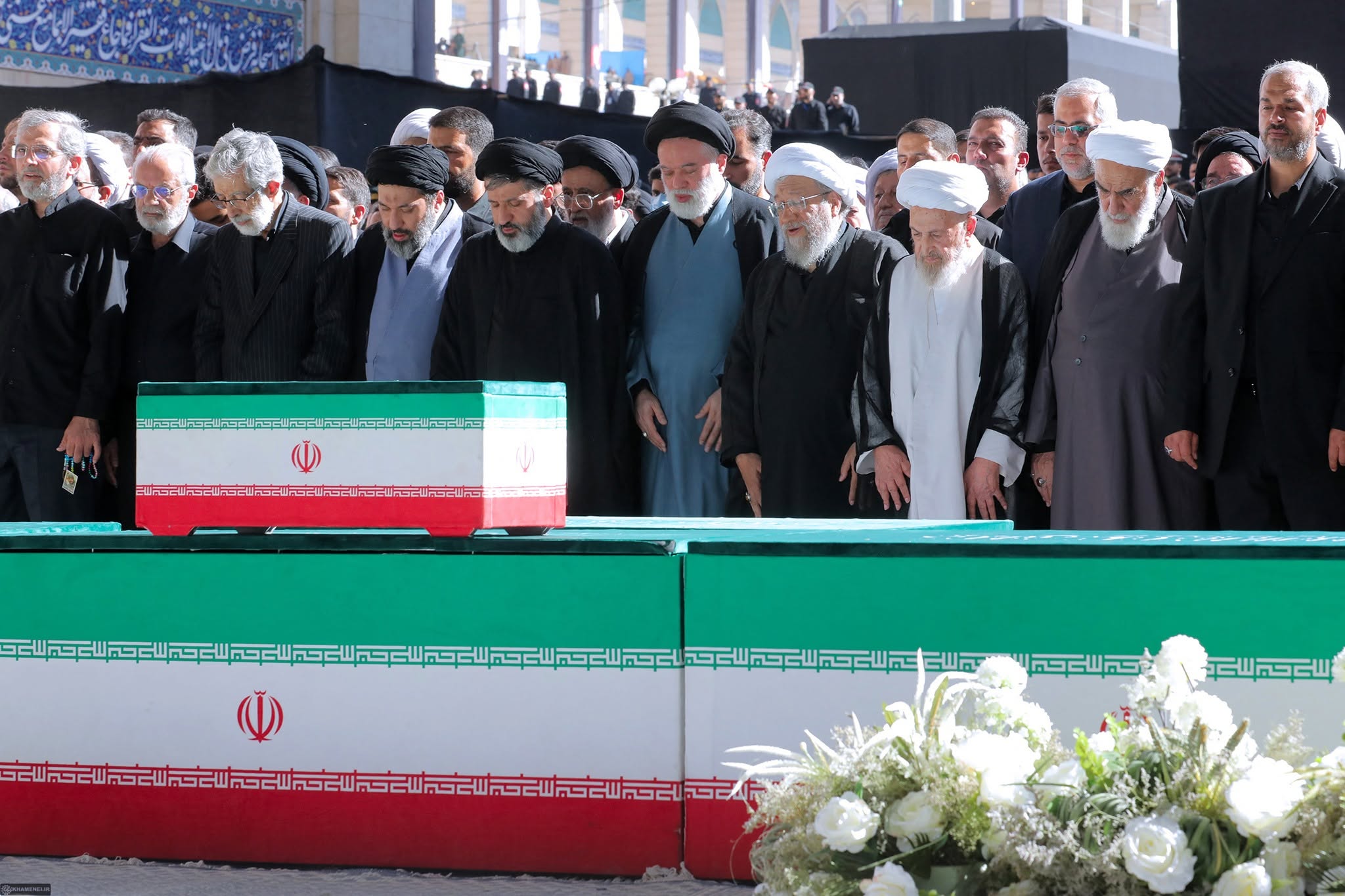
The funeral procession for Ayatollah Ali Khamenei, Iran's supreme leader for more than three decades who was killed on February 28 in the opening wave of joint US-Israeli airstrikes that began the war, drew tens of thousands of people into the streets of central Tehran on Monday in the biggest single day of a week-long series of memorial ceremonies. Drone footage broadcast on Iranian state television showed crowds crammed into a central boulevard as a large truck carrying the caskets of Khamenei funeral and four family members moved slowly through the procession route, while fire hoses sprayed water overhead to keep the marchers cool in the summer heat.
The ceremony had been significantly delayed. The funeral was originally scheduled for March 4, with mourners invited to pay their respects as Khamenei lay in state at Tehran's Grand Mosalla Mosque. Iranian officials postponed it entirely, with Seyyed Mohsen Mahmoudi, head of the Islamic Propaganda Coordination Council of Tehran, citing "the high volume of requests to attend this ceremony and the need to provide appropriate facilities to host the people." More than four months passed between the supreme leader's death and Monday's procession, a delay shaped by the ongoing war, logistical demands, and the political sensitivities of staging a ceremony of this magnitude while the regime was simultaneously negotiating a peace deal with the country that killed him.
The procession carried five caskets: Khamenei himself, one of his daughters, her 14-month-old child, one of his sons-in-law, and the wife of his son Mojtaba, who has since been named as Iran's new supreme leader. Mourning ceremonies had begun on Friday when the caskets lay in state for Iranian officials and foreign dignitaries, followed by large outdoor gatherings on Saturday and Sunday before Monday's procession. Authorities announced the body would travel later this week to the Shi'ite seminary city of Qom and to two Shi'ite shrine cities in neighbouring Iraq before returning to Iran for burial inside a medieval shrine complex in Mashhad.
Anti-US sentiment dominated the procession as mourners displayed placards calling for vengeance and burned American and British flags
The political atmosphere of Monday's procession was saturated with rage toward the United States and Israel. Mourners hurled stones at a billboard depicting President Donald Trump as they passed beneath a bridge, and demonstrators burned American and British flags along the route. Women in black chadors held placards expressing violent vengeance against US and Israeli leaders, while larger crowds waved Iranian flags and red banners invoking Shi'ite Islamic tradition, adapting a phrase rooted in the seventh-century death of the Prophet Muhammad's grandson to call for the "avengers of Khamenei" to act.
The display of mass public grief and political anger served a dual purpose for Iran's surviving clerical leadership. On one level it was a genuine expression of mourning in a country whose supreme leader had held power for 35 years and whose death, alongside members of his immediate family including a 14-month-old grandchild, was experienced as a national trauma by millions of Iranians loyal to the Islamic Republic. On another level it was a demonstration of institutional resilience, evidence that the strikes which decapitated much of the Iranian leadership had not broken the regime's capacity to mobilise public displays of loyalty and political solidarity at scale.
The size and intensity of the crowds carried a deliberate international message as well. Iran's new leadership, operating under the preliminary peace agreement reached last month that ended the war without achieving the disarmament goals the US and Israel had set at the outset, needed the funeral ceremonies to function as a proof of legitimacy. Hundreds of thousands of people in the streets of Tehran, channelling grief into political defiance, provided precisely that. For Washington and Tel Aviv watching the footage from state television, the scenes were an unambiguous signal that the war had not produced the conditions for the Islamic Republic's internal collapse that some in both governments had anticipated.
Why Mojtaba Khamenei's absence from his own father's funeral is the most significant political signal of the entire week
The most consequential detail of Monday's procession was not what happened but what did not: Mojtaba Khamenei, the son who succeeded his father as Iran's supreme leader and who was selected by Iran's Assembly of Experts for the role, did not appear publicly at the funeral. Three of his brothers prayed beside the casket at Tehran's prayer hall on Sunday, but Mojtaba was absent. He has not been seen publicly at any point since the war began on February 28, and reports suggest he was injured in the initial strikes that killed his father.
The political implications of a supreme leader who cannot or will not appear in public four months into his tenure are significant and unresolved. Iran's system of governance places enormous symbolic and institutional weight on the figure of the supreme leader as a unifying religious and political authority. A leader who remains invisible during the most publicly charged moment of the post-war period, his own father's funeral, raises questions about his physical condition, his political authority within the clerical establishment, and whether the men who are visibly running the government, parliamentary speaker Mohammad Bagher Ghalibaf and Revolutionary Guard commander Ahmad Vahidi, are exercising power that formally belongs to someone the country has not seen since February.
Vali Nasr, professor of International Affairs and Middle East Studies at Johns Hopkins' School of Advanced International Studies, has argued that Iran's new leadership is meaningfully different from the generation Washington became accustomed to dealing with, describing them as not the kind of people typically called apocalyptic ideologues. Whether that assessment holds will depend on decisions made in the coming months, as the 60-day peace negotiation window closes and Iran's new leadership must decide how aggressively to pursue reconstruction funding, nuclear programme positioning, and regional proxy network rebuilding under a regime that survived the war with its institutional structure largely intact even as its most prominent figures were killed.
What the war's outcome, the preliminary peace deal, and Israel's warning to Iran's new leadership mean for regional stability
The war that began on February 28 with the strikes that killed Khamenei ended with a preliminary peace agreement reached last month, and both sides have claimed victory in ways that are mutually incompatible. Trump said over the weekend that peace talks had been delayed for a week by the funeral ceremonies, a statement that frames the mourning of a killed leader as an inconvenience to a diplomatic schedule, a framing that will not have escaped the attention of Iranian negotiators. Iran's clerical leadership, for its part, has claimed victory on the grounds that the regime survived, retained power, and demonstrated control over the Strait of Hormuz, through which roughly 20 percent of global oil trade flows.
Israel Defence Minister Israel Katz issued a direct warning to Iran's new leadership on Monday, stating that Khamenei had been killed because he led a programme to destroy Israel. "Any Iranian leader who will again try to pursue plans to destroy Israel will be killed as well," Katz said. That statement, delivered on the day of Khamenei's funeral procession, is a deliberate and pointed message to Mojtaba Khamenei and to the clerical establishment that selected him: the same military doctrine that killed the father remains in effect for the son. It is also a statement that will be read carefully by Iran's Revolutionary Guard commanders as they assess what the post-war security environment actually permits.
Trump, meanwhile, acknowledged over the weekend that the aims he had stated at the war's outset, destroying Iran's nuclear and missile capabilities, ending its ability to attack neighbours, and creating conditions for Iranians to remove their own leaders, had not been achieved. That gap between stated objectives and actual outcomes is the central unresolved tension of the post-war diplomatic moment. The 60-day negotiating window created by the preliminary agreement will determine whether the peace produces something durable or simply pauses a conflict whose underlying drivers, Iran's nuclear programme, its regional proxy networks, and Israeli and American threat assessments, remain fully intact on both sides.