
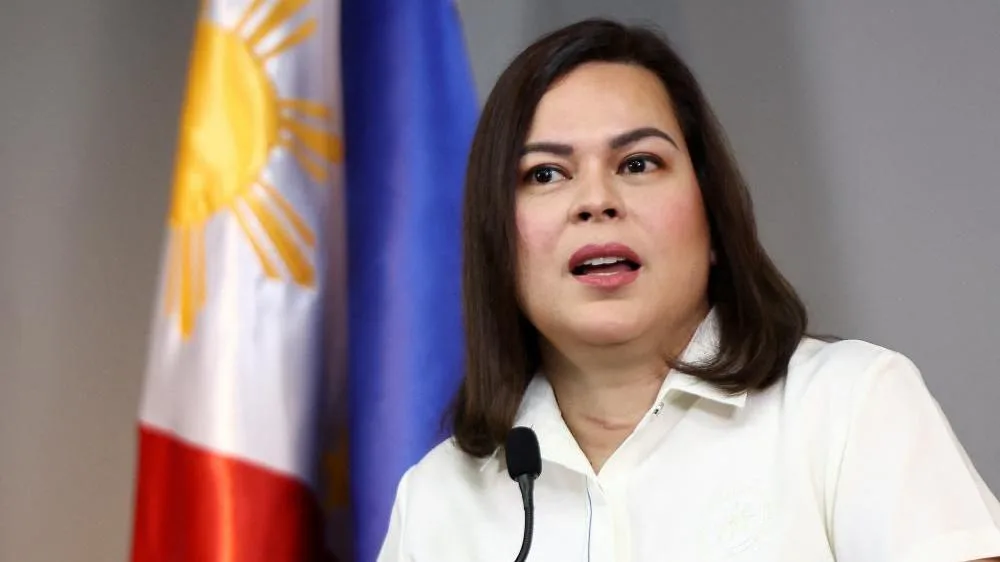
The impeachment trial of Philippine Vice President Sara Duterte formally opened on Tuesday in Manila, placing both her political career and any prospect of a 2028 presidential run under direct judicial threat. If the Senate, sitting as an impeachment court, votes to convict her by the required majority of 16 of 24 senators, Duterte will be removed from the vice presidency and permanently barred from holding any public office in the Philippines. That outcome would eliminate from the country's political landscape a figure who received 32 million votes in the 2022 election, more than President Ferdinand Marcos Jr himself or any of the legislators now sitting in judgment of her.
The charges against Duterte are serious and specific. She faces allegations of misusing millions of dollars in public funds during her tenure as education minister, centred on expense claims she has refused to explain in detail, citing confidentiality requirements. She also faces allegations of threatening to have President Marcos assassinated, a charge that sits at the extreme end of the political feud between two dynasties that once won a landslide election together and have since become each other's most dangerous enemies. Duterte was absent from the trial's opening day, a decision her lawyer framed as a principled choice rather than a tactical retreat, though the prosecution and the Marcos camp read it differently.
The political stakes extend far beyond Sara Duterte as an individual. Her father, former President Rodrigo Duterte, built one of the most powerful political machines in modern Philippine history on the back of his war on drugs and a populist appeal to voters who felt left behind by the country's traditional elites. His daughter inherited that coalition, expanded it, and turned it into a 32-million-vote mandate that made her the most electorally successful politician in the country in 2022. Convicting and removing her would not extinguish that political force. It would redirect it, almost certainly into opposition, potentially into street politics, and possibly into a sustained effort to delegitimise the Marcos presidency by any means available.
How the Marcos-Duterte alliance collapsed after 2022 and produced the political crisis now playing out in the Senate
The Marcos-Duterte alliance that won the 2022 Philippine election was always a coalition of convenience rather than conviction, built on complementary electoral bases rather than shared political values. Marcos brought the old Ilocos Norte political machinery and a rehabilitated family name to the partnership. Duterte brought her father's working-class populist network and the southern Philippines voter base that Rodrigo Duterte had cultivated over decades as Davao City mayor and then as president. Together they were formidable. Apart, they were always going to be rivals.
The implosion of the alliance happened in public and with notable speed. Within months of taking office, the two camps began trading accusations and maneuvering against each other in both the Senate and the House of Representatives. The political dynamics of the Philippines, where legislative alliances are fluid and loyalty is routinely purchased or withdrawn based on short-term calculation, accelerated the breakdown rather than containing it. By 2026, the Senate had gone through four different presidents in a single year, each leadership change decided by the defection of just a few senators who recalculated where their interests lay, a pattern the local press was accurately describing as a rolling series of coups in miniature.
The impeachment proceedings cannot be separated from that broader power struggle. Congresswoman Gerville Luistro, delivering the prosecution's opening argument, drew a pointed comparison between the accountability applied to ordinary public servants and the apparent insulation of the most powerful from equivalent scrutiny. "If a small village treasurer can't explain missing funds, he is investigated. If a school principal squanders public funds, even just 5,000 pesos, she is punished. If ordinary people are held to account, why not the most powerful government official?" The argument is designed to frame the trial as a justice question rather than a political one, because framing it as a political question immediately raises the mirror-image accusation that the prosecution itself is the political act.
Why the Senate vote is genuinely unpredictable and what the ICC complications mean for Duterte's defence
The outcome of the impeachment trial is genuinely difficult to forecast, and that uncertainty is itself the most important political fact about it. The Philippine Senate is split between senators aligned with Marcos and senators aligned with Duterte, but neither bloc has a reliable majority, and Philippine political history is a long series of demonstrations that alignment is contingent rather than permanent. The Senate has had four presidents in 2026 alone, each change engineered by a handful of defections. The senators who will ultimately decide Sara Duterte's fate are people who have already demonstrated in this calendar year that their commitments are negotiable.
The International Criminal Court dimension adds a layer of legal and political complexity that is genuinely unusual even by the standards of Philippine politics. Two senators allied with Duterte have been arrested in recent weeks. A third, Bato dela Rosa, who was the chief enforcer of Rodrigo Duterte's war on drugs from 2016 to 2018 and who faces an unsealed ICC arrest warrant, has gone into hiding. Whether these three senators can vote in absentia remains legally unresolved, and the answer matters enormously: their votes could be the deciding margin in a trial where the conviction threshold is 16 of 24 and every senator counts.
Sara Duterte's lawyer Sheila Sison did not contest the charges in procedural terms on opening day but attacked the legitimacy of the entire proceeding. "It is clear that the objective is to oust her," Sison said, framing the trial explicitly as political persecution rather than legal accountability. That defence strategy is as much about the court of public opinion as the Senate chamber, because Duterte's political survival, even if she loses the trial, depends on maintaining the loyalty of the 32 million voters who chose her in 2022 and who could become the foundation of a political comeback if the impeachment is successfully branded as a political hit job orchestrated by a rival dynasty.
What conviction or acquittal means for Philippine democracy, the 2028 election, and the Duterte dynasty's future
A conviction would produce two immediate consequences with long-term political implications. Sara Duterte would be removed as vice president and permanently barred from public office, eliminating her from the 2028 presidential race before it formally begins. That outcome would represent the most significant use of the impeachment mechanism in Philippine history and would establish a precedent that dynastic political immunity has limits even at the highest levels of government. Whether that precedent strengthens Philippine democratic institutions or simply empowers whichever faction controls the Senate at any given moment to weaponise impeachment against rivals is a question the country's political scientists are already debating.
An acquittal would have equally significant consequences in the opposite direction. It would validate Duterte's framing that the trial was political prosecution rather than legitimate accountability, strengthen her claim to democratic legitimacy ahead of 2028, and potentially accelerate the political rehabilitation of the broader Duterte movement in the aftermath of Rodrigo Duterte's ICC-related legal jeopardy. It would also weaken the Marcos administration domestically, making it harder to sustain the political offensive against its most powerful domestic rival and raising questions about whether the Senate is truly independent or simply the arena in which dynastic battles are fought to inconclusive draws.
The deeper political analysis of the moment is that the Marcos-Duterte conflict has exposed a structural fragility in Philippine political institutions that neither dynasty created but both are now exploiting. A political system where four Senate presidents can come and go in a single year, where ICC fugitives sit as legislators, where a 32-million-vote mandate does not protect its holder from impeachment and a sitting vice president does not attend her own trial, is a system whose institutional authority is being tested by forces it was not designed to contain. The 92-day trial will produce a verdict. Whether that verdict produces legitimacy, or simply the next round of the same fight, is the question that will define Philippine politics well beyond the Marcos and Duterte dynasties themselves.